
If you are specifying, procuring, or approving structural steel for an industrial building project, here is the decision-critical information you need about steel beams in a single guide:
- Which beam profile is structurally efficient for your span and load
- Which sizes and grades correspond to the standards used in your project region (AISC for the US/Gulf, EN for Europe/Australia, AS/NZS for Australia, regional codes for Southeast Asia)
- Why a standard hot-rolled section is not always the right answer — and when a purpose-engineered built-up beam delivers lower total installed cost
- What procurement and logistics factors add hidden cost to beam selection in cross-border industrial projects
This guide does not hedge for residential DIY applications. It is written for B2B decision-makers managing 5,000 m² to 200,000 m² industrial buildings.
1. What Is a Steel Beam — Role in the Structural Frame
A steel beam is a structural member designed primarily to resist bending loads — the gravity forces (dead load and live load) applied perpendicular to its longitudinal axis — and to transfer those loads to columns, walls, or adjacent framing members, which ultimately deliver the force to the foundation.
In any steel-framed building, the beam’s function is not ornamental. It defines clear spans (the unobstructed distance between supports), governs floor-to-floor height, determines deflection (how much the structure moves under load), and drives a significant share of the steel tonnage — and therefore the cost — in the primary structural frame.
Why beam selection matters at the project level: A well-specified beam reduces self-weight (which reduces column sizes, bracing demands, and foundation loads), improves erection speed, and lowers the total installed cost. An under-specified beam is a safety issue. An over-specified beam is a budget waste that compounds across hundreds of members.
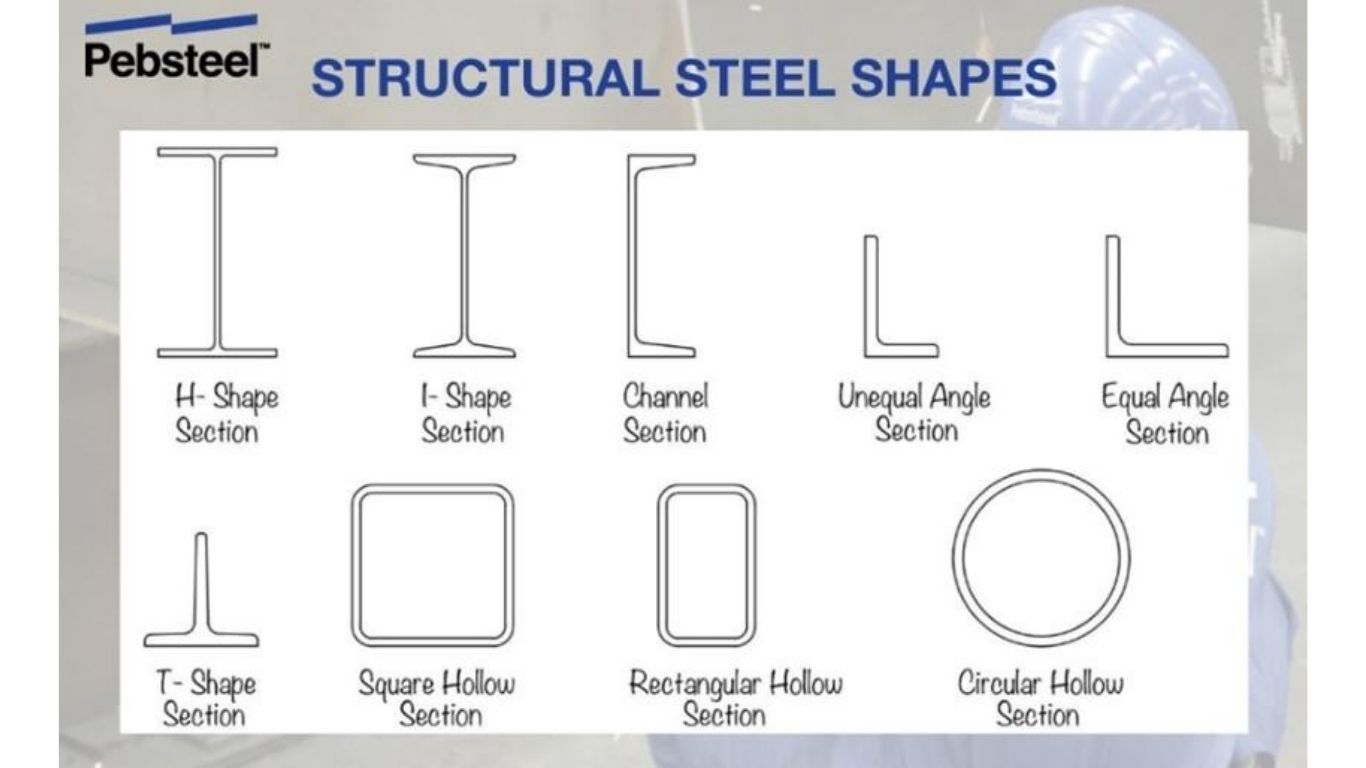
2. Types of Steel Beams: Technical Comparison
2.1 Wide Flange Beam (W-Beam)
The wide flange beam — designated “W” in North American (AISC) nomenclature and “UB” (Universal Beam) or “HE/IPE” in European (EN) nomenclature — is the most widely used structural beam profile in modern industrial construction globally.
Key characteristics:
- Parallel flanges (flat, not tapered) with uniform thickness
- Wide flange width relative to depth improves lateral stability
- High section modulus per unit weight — efficient use of material
- Available in a very wide range of sections (W4 to W44 in AISC; IPE 80 to IPE 600 and HE 100A to HE 1000M in EN)
Best for: Primary floor beams and secondary framing in multi-storey industrial, commercial, and logistics facilities; crane girders; large-span roof beams.
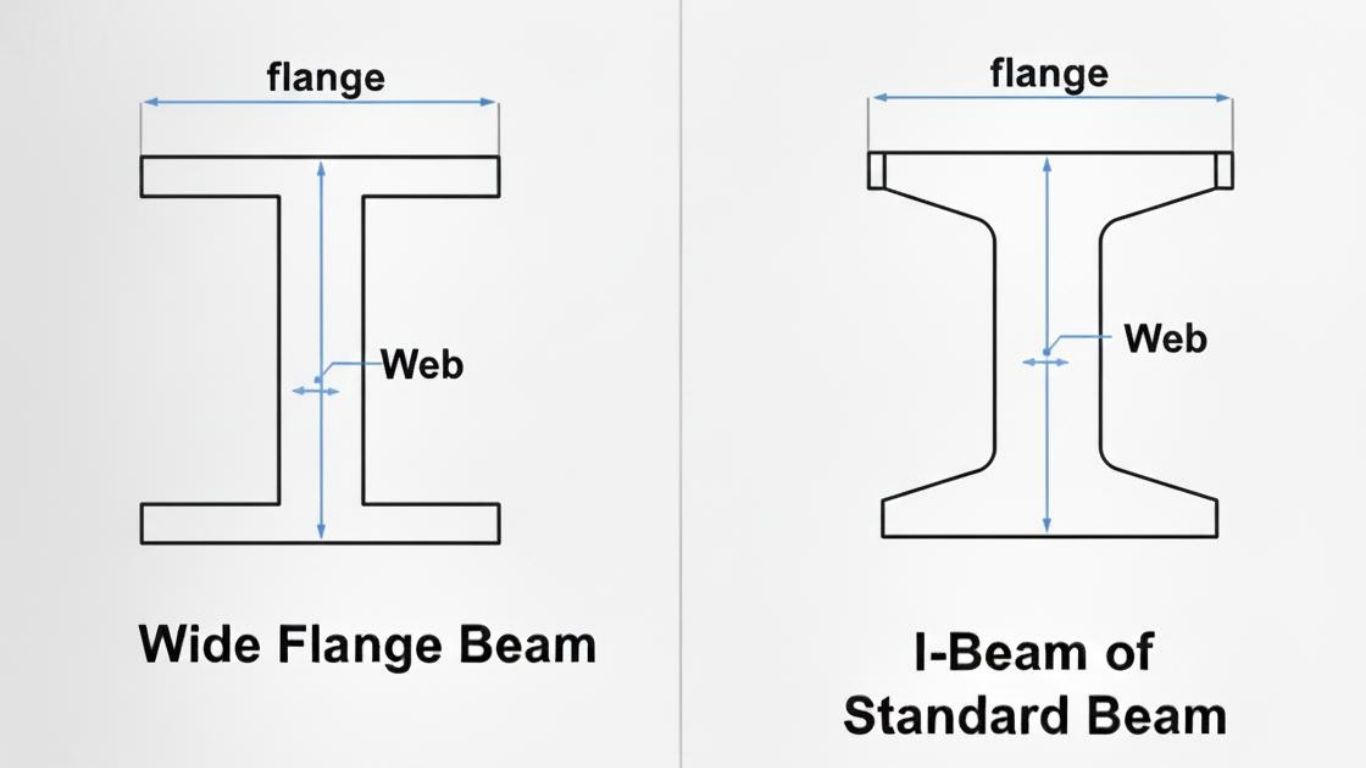
2.2 I-Beam (S-Beam / American Standard Beam)
The S-beam (Standard I-beam in AISC; “S” for Standard) has a narrower flange and tapered flanges (thicker at the web junction, thinner at the edges), distinguishing it from the wide flange.
Key characteristics:
- Less efficient than W-beams for the same depth due to narrower effective flange
- Still commonly encountered in renovation work, plant modifications, and specific connection configurations
- Designated as “S depth × weight/ft” (e.g., S12×50 = 12 in. deep, 50 lb/ft)
Best for: Retrofit and maintenance projects on older structures; specific mechanical and industrial support applications.
2.3 H-Beam (Heavy Wide Flange / HD Sections)
Often used interchangeably with “wide flange” in Asian and Middle Eastern markets, the H-beam in strict EN terms refers to the HEM, HEA, HEB, or HEA series — heavy sections where the flange width approximately equals the depth.
Key characteristics:
- Near-square cross-section makes H-beams excellent as both columns and beams
- Greater flange area vs web height compared to standard W-beams — higher resistance to biaxial bending and compression
- Commonly used in crane runway girders, heavily loaded transfer beams, and industrial mezzanine primary members
Regional note for Southeast Asia and the Middle East: In project specifications from Chinese, Korean, or Japanese steel mills — significant supply sources for both regions — H-beams are designated by the Chinese GB/T 11263 or JIS A 6901 standard, with sizes such as HN 400×200 (nominal depth × flange width, both in mm). Engineers working across multiple supply chains must reconcile these designations with AISC and EN sections.
2.4 Universal Beam (UB) — Australian and UK Standard
In Australia and New Zealand (and the UK), the standard hot-rolled beam is the Universal Beam (UB), governed by AS/NZS 3678 for material and AS/NZS 3679.1 for structural sections.
Designation format: UB depth (mm) × weight (kg/m) — e.g., 460UB67.1 = 460 mm nominal depth, 67.1 kg/m.
Key characteristics:
- Functionally equivalent to EN UB/IPE and AISC W-beams but with distinct size tables
- AS 4100 is the primary design standard; the beam must be selected from tables compliant with that standard
- 300PLUS® steel (minimum 300 MPa yield) is the dominant grade in Australian projects
2.5 Hollow Structural Sections (HSS / RHS / SHS / CHS)
Hollow Structural Sections — rectangular (RHS), square (SHS), and circular (CHS) — are not typically primary floor beams but appear frequently as secondary members, crane bracing, architectural exposed elements, and transfer beams in specialty applications.
Key characteristics:
- Excellent torsional resistance — critical where beams are eccentrically loaded or exposed to lateral forces along the longitudinal axis
- Clean aesthetic — frequently used in architecturally exposed steel
- More expensive per tonne than open sections due to more complex rolling/forming process; connection details are also more complex
2.6 Castellated & Cellular Beams
Castellated beams (hexagonal web openings) and cellular beams (circular web openings) are fabricated from standard W or UB sections by cutting and rewelding the web to increase the beam depth without adding steel weight.
Key characteristics:
- 40–60% deeper than the parent section, with no increase in steel tonnage
- Web openings can be used for services routing (HVAC ducts, pipes, cable trays) — eliminates the floor zone required for services below the beam
- Common in long-span commercial office and logistics buildings where floor-to-floor efficiency is critical
2.7 Plate Girders
For spans or loads that exceed the capacity of standard rolled sections — typically spans over 25–30 m or very heavy crane loads — a plate girder is fabricated by welding steel plates (flanges + web) into a custom I-section.
Key characteristics:
- Completely custom: depth, flange width, web thickness, and flange thickness are all specified by the engineer
- Typical applications: bridge girders, aircraft hangar main frames, long-span industrial roof structures, heavy-duty overhead crane runway girders (up to 500 t capacity)
- Fabrication cost is significantly higher than rolled sections; economical only when standard sections are structurally inadequate
3. Steel Beam Sizes: How to Read Designations
AISC (North America / Middle East ASTM-referenced projects)
| Designation | Meaning | Example |
|---|---|---|
| W18×97 | Wide flange, 18 in. nominal depth, 97 lb/ft | W18×97: d=18.6″, bf=11.1″, tf=0.87″, tw=0.535″ |
| S12×50 | Standard I-beam, 12 in. depth, 50 lb/ft | |
| W36×300 | Heavy wide flange for long spans |
EN (Europe / Southeast Asia projects using EU supply)
| Designation | Meaning | Example |
|---|---|---|
| IPE 300 | I-section, 300 mm depth (European standard series) | |
| HEA 240 | H-beam, 240 mm depth, series A (lightweight) | |
| HEB 300 | H-beam, 300 mm depth, series B (standard) | |
| HEM 400 | H-beam, 400 mm depth, series M (heavy) |
AS/NZS (Australia & New Zealand)
| Designation | Meaning | Example |
|---|---|---|
| 530UB92.4 | Universal Beam, 530 mm nominal depth, 92.4 kg/m | |
| 310UC96.8 | Universal Column, 310 mm depth, 96.8 kg/m |
Chinese / JIS (Southeast Asia, Middle East from Asian mills)
| Designation | Meaning |
|---|---|
| HN 500×200 | H-beam narrow flange, 500 mm depth × 200 mm flange |
| HW 250×250 | H-beam wide flange (near-square), 250×250 mm |
| HM 400×300 | H-beam medium flange |
Procurement note: When cross-referencing sections across standards — for example substituting a HN500×200 for a W18×97 or 530UB82.0 — always verify that the section modulus (S_x), moment of inertia (I_x), and web shear area meet the engineering requirements. Nominal designations do not guarantee structural equivalence.
4. Steel Grades & Mechanical Properties
| Standard | Grade | Min. Yield Strength | Min. Tensile Strength | Common Use |
|---|---|---|---|---|
| ASTM A992 | Fy=50 ksi | 345 MPa | 450 MPa | W-shapes, most common US structural beams |
| ASTM A572 Gr.50 | 345 MPa | 450 MPa | General structural beams, plates | |
| EN 10025-2 | S275 | 275 MPa | 430 MPa | Standard grade Europe |
| EN 10025-2 | S355 | 355 MPa | 490 MPa | High-strength structural sections |
| AS/NZS 3678 | 300PLUS® | 300 MPa | 440 MPa | Standard Australian structural sections |
| AS/NZS 3678 | Grade 350 | 350 MPa | 480 MPa | Higher-strength Australian sections |
| GB/T 1591 | Q355B | 355 MPa | 490–630 MPa | Chinese mill H-beams for SEA projects |
| JIS G3136 | SN400A | 235 MPa | 400–510 MPa | Japanese mill sections |
Grade selection note: Higher-yield grades (S355, ASTM A992) allow lighter sections, reducing steel tonnage and transport cost — important for projects where logistical cost is high, such as remote sites in Southeast Asia or offshore island projects in the Gulf.
5. International Standards: AISC, EN, AS/NZS & Regional Codes
Design Standards by Region
| Region | Primary Design Standard | Material Standard | Notes |
|---|---|---|---|
| United States | AISC 360 (LRFD/ASD) | ASTM A992, A572 | Widely referenced in Gulf projects under US EPC firms |
| Europe | Eurocode 3 (EN 1993-1-1) | EN 10025 | Referenced in EU-funded SEA projects |
| Australia / NZ | AS 4100 | AS/NZS 3678, 3679 | Mandatory for Australian projects; NCC compliance |
| Gulf Cooperation Council | IBC + ASCE 7 + AISC 360 | ASTM / EN | SASO and local municipality requirements overlay |
| Saudi Arabia | SBC (Saudi Building Code) | ASTM / EN dual | SBC-301 structural, SBC-201 loads |
| UAE | Abu Dhabi IRC / Dubai Building Code | ASTM / EN | Emirate-specific; seismic per ASCE 7 |
| Vietnam | TCVN 5575:2024 | TCVN 7571 | Hot-rolled sections; foreign investors often allow AISC/EN |
| Indonesia | SNI 1729:2020 (based on AISC 360) | SNI steel grades | Strong AISC alignment post-2020 revision |
| Malaysia | MS EN 1993 (Eurocode-aligned) | MS EN 10025 | Eurocode adoption ongoing |
| Thailand | EIT Standard | ASTM / TIS | TIS 1227 for structural steel sections |
| Philippines | NSCP (National Structural Code) | AISC-aligned |
READY TO BUILD?
Get a free engineering consultation and itemised quotation from PEB Steel’s team of 100+ structural engineers.
31+ years | 50+ countries | 100+ in-house engineers | AISC-designed buildings
6. Composite Steel Beams
Composite construction — where a steel beam works together with a reinforced concrete slab through mechanical shear connectors (headed shear studs) — is the standard approach for multi-storey steel floor systems globally and one of the most significant content gaps in all competing guides.
How It Works
In a composite floor beam, the concrete slab acts as a compressive flange, increasing the effective section modulus by 30–50% compared to the bare steel section. This means:
- A lighter steel beam section can span the same distance as a heavier non-composite section
- Steel tonnage per square metre of floor is reduced
- Reduced self-weight lowers column sizes, bracing demands, and foundation loads
Key Parameters
- Shear stud density: Partial or full composite action depending on the design — partial (typically 40–75% composite) is often most economical
- Deck geometry: Profiled steel deck (51 mm, 76 mm, or 80 mm rib depth) used as permanent formwork. Perpendicular ribs reduce shear stud effectiveness (reduction factor per AISC 360 Chapter I or EN 1994-1-1)
- Total slab thickness: Typically 130–160 mm for industrial mezzanine floors; finished weight ≈ 2.5–3.5 kN/m² vs 4.8 kN/m² for an equivalent 200 mm RC flat slab
Relevance for Target Markets
Composite floors are increasingly common in multi-storey logistics and cold-storage facilities in Singapore, Malaysia, and Australia, where maximising rentable floor area within strict height envelopes is commercially critical.
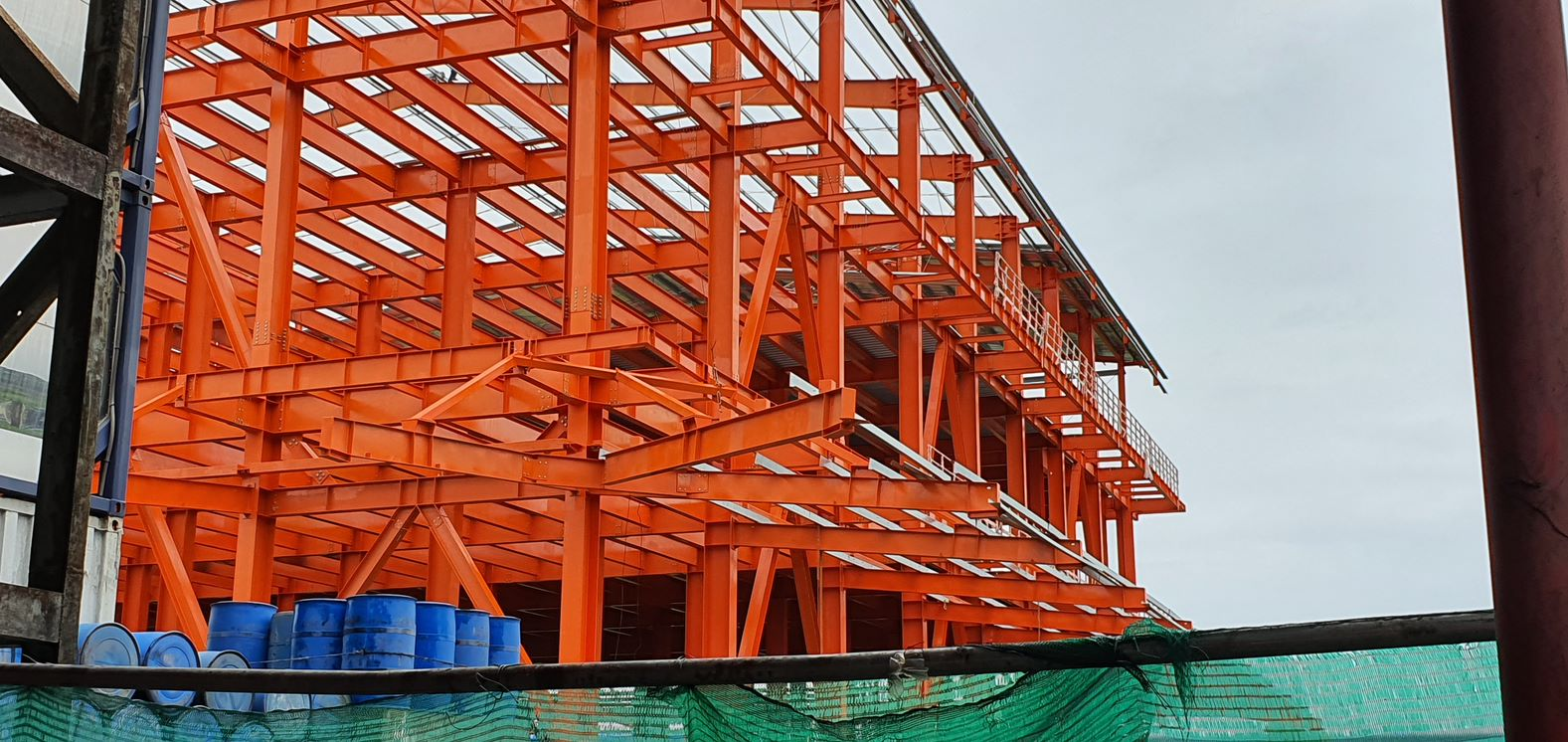
7. Tapered Built-Up Beams in Pre-Engineered Building Systems
Standard hot-rolled sections are optimised for catalogue production: one depth, one weight per metre, consistent along the full length. But in a single-storey industrial building — a warehouse, a factory, an aircraft hangar — the bending moment in the rafter or beam is not constant along its length. It peaks at mid-span or at the haunch connection and diminishes toward the pin base.
A tapered built-up beam matches its cross-section to the bending moment diagram: deeper at high-moment zones, shallower elsewhere. The result is a structural member that uses steel only where the load demands it.
Why This Matters for Cost
| Metric | Standard Hot-Rolled W-Beam | Tapered Built-Up Beam (PEB) |
|---|---|---|
| Steel utilisation efficiency | ~60–70% average fibre stress | ~85–90% average fibre stress |
| Typical weight saving vs equivalent span | Baseline | 15–30% lighter |
| Custom span capability | Limited to standard section capacities | Engineered for exact project span and load |
| Connection optimisation | Standard end-plate; moment not optimised | Haunched moment connections; column splice at optimum location |
PEB Steel designs all primary structural frames using purpose-engineered tapered built-up rafters and columns, fabricated to AISC 360 and MBMA Manual, with steel fabrication quality provisions per EN 1090. This approach delivers a lower steel tonnage than a conventional framing solution using catalogue sections — which means lower freight cost (critical for projects in remote Southeast Asian locations or island sites in the Gulf), shorter erection time, and a lower total installed cost.
8. Engineering Criteria for Beam Selection
Selecting the correct steel beam for a given application requires evaluation of six engineering criteria:
- Bending moment capacity (M_n): The beam must resist the factored bending moment at all critical sections. Governed by yield strength, section modulus, and lateral-torsional buckling (LTB) behaviour.
- Shear capacity (V_n): Web shear must be checked, particularly for short spans with high concentrated loads (crane runways, loading docks, equipment pads).
- Deflection limits: Live-load deflection typically limited to L/360 for floor beams; total load deflection L/240. For crane runway beams, more stringent limits apply (L/600 to L/1000 depending on crane class and bridge type).
- Lateral-torsional buckling (LTB): Beams with unbraced compression flanges are susceptible to LTB — the beam twists and buckles laterally before reaching its full moment capacity. LTB is controlled by reducing unbraced length (adding intermediate purlins or bracing) or selecting a section with a higher LTB resistance (wider flange, greater weak-axis moment of inertia).
- Web crippling and local buckling: At concentrated load points (column reactions, beam-to-beam connections), the web must be checked for crippling; plate slenderness ratios must comply with compact/non-compact section limits.
- Connection geometry: The selected beam must accommodate the required connection (end plate, flange plate, shear tab) without local stiffening that adds fabrication cost. This is particularly important for deep sections where welding access is limited.
9. Corrosion Protection in Tropical & Arid Climates
Corrosion is one of the most significant long-term cost factors for structural steel in Southeast Asia, the Middle East, and parts of coastal Australia — and it is entirely absent from most “steel beam” guides published by North American suppliers.
Southeast Asia (High Humidity, Tropical)
- Annual corrosivity category: C3 (medium) to C4 (high) in most coastal and industrial zones per ISO 9223
- Standard protection: Hot-dip galvanising (HDG) for secondary members; surface preparation Sa 2.5 + epoxy primer + polyurethane topcoat for primary frames
- Paint system thickness: Typically 200–320 μm DFT for a 15–20-year design life in C4 environments
- Special consideration: Industrial chemical exposure (ports, petrochemical facilities) may require C5-M rated systems (400+ μm DFT) with zinc-rich primers
Middle East (High Heat, High Humidity Coastal + Dust Arid Inland)
- Coastal Gulf (e.g., UAE, Kuwait, eastern Saudi Arabia): C4–C5-M classification; airborne chlorides accelerate corrosion substantially; zinc thermal spray (TSZ) increasingly specified
- Arid interior: Lower corrosivity (C2–C3) but UV degradation of topcoats is a factor; chalking-resistant polysiloxane finishes are preferred
- Fireproofing interaction: In petrochemical facilities, intumescent fireproofing is applied over the anti-corrosion primer; the full system (primer + intumescent + topcoat) must be compatible and tested as a system
Australia & New Zealand
- AS/NZS 2312.1 governs coating selection by environment
- Coastal and marine zones (C4–CX): Hot-dip galvanising plus overcoating, or full paint system with zinc silicate primer
- Bushfire-prone areas: NCC requires assessment under AS 3959 — steel members exposed to radiant heat must be protected
10. Regional Compliance: Southeast Asia, Middle East, Australia
What “Compliance” Means at the Procurement Stage
Compliance is not simply a matter of which design standard is used. For cross-border procurement — buying beams from a Vietnamese, Chinese, Korean, or Indian mill for a project in Australia, Saudi Arabia, or Indonesia — compliance also involves:
Material certification:
- Mill certificates (MTC) per EN 10204 Type 3.1 (third-party witnessed test results) required for most GCC and Australian projects
- AS/NZS 3678/3679 requires Australian or NATA-accredited laboratory test certification for sections used in Australian projects governed by AS 4100
- TCVN projects in Vietnam may accept TCVN, JIS, EN, or ASTM MTCs depending on the client and consultant
Third-party inspection:
- Australian projects: Typically require third-party inspection per AS/NZS 1554 weld quality requirements and EN 1090 fabrication execution class (EXC2 or EXC3 for most industrial projects)
- Saudi Aramco-supply projects: SAES standards and vendor approval process; factory qualification audit required
- UAE municipality projects: Dubai Municipality approval and/or Abu Dhabi DMT approval for structural elements
Structural engineering endorsement:
- In Australia, a Registered Structural Engineer (CPEng or RPEQ) must certify the design; foreign PEB suppliers must work through a local Engineering firm
- In the UAE, an approved structural engineer registered with the relevant authority must sign off the design
- In Indonesia, SNI 1729:2020 compliance must be certified by a professional engineer registered under the Indonesian Professional Engineering Body (PII)
11. Procurement Strategy & Lead Times for Large Industrial Projects
Supply Chain Considerations for Industrial-Scale Projects
For a 20,000–80,000 m² industrial facility, the steel beam procurement decision is rarely about finding the cheapest section per kilogram. It is about managing risk across the full project schedule.
Key lead time benchmarks (indicative, market-dependent):
| Supply Scenario | Typical Lead Time |
|---|---|
| Ex-stock standard sections (local distributor, SEA or GCC) | 2–4 weeks |
| Mill order, standard W/UB/HE sections, Asian mills | 8–14 weeks |
| Mill order with specific certification (EN 3.1 MTC) | +2–4 weeks |
| Fabricated built-up beams (PEB primary frames) | 10–16 weeks from design sign-off |
| Plate girders for heavy crane runways | 14–20 weeks |
Procurement risk factors specific to target markets:
- Port congestion: Singapore, Jakarta (Tanjung Priok), Port Klang, and Dubai’s Jebel Ali experience periodic congestion; add 2–4 weeks contingency for break-bulk steel shipments
- Import duty: Indonesia and Vietnam impose import duties on structural steel sections from certain origins; verify HS code 7308.90 / 7216.xx duties before finalising mill selection
- Currency volatility: USD-denominated steel purchases create exposure in VND, IDR, PHP, and MYR contracts; risk should be assigned explicitly in the supply agreement
The Advantage of an Integrated PEB Supplier
For projects where the primary structure, secondary structure, and cladding are sourced from a single PEB manufacturer, the beam procurement decision is absorbed into a single supply contract. The fabricator manages mill procurement, certification, fabrication, painting, and delivery to site — and the project team tracks a single schedule milestone instead of five separate supply chains.
12. Total Installed Cost vs Material Cost: The Correct Metric
The single most common error in steel beam procurement is optimising for material cost per tonne rather than total installed cost per square metre of building.
Total installed cost of a steel beam includes:
| Cost Component | What It Includes |
|---|---|
| Material cost | Mill section cost × tonnage |
| Fabrication cost | Connection details, stiffeners, weld length, NDT inspection |
| Surface treatment | Blasting, primer, intermediate & topcoat; fireproofing |
| Freight & logistics | International shipping, import duties, local delivery to site |
| Erection cost | Crane lifts, temporary bracing, bolt installation |
| Foundation cost | Column base reactions driven by beam weight and span |
A heavier standard rolled section may cost less per tonne ex-mill than a fabricated tapered beam. But if the tapered beam is 20% lighter (fewer crane lifts, lower freight cost, smaller foundation pads) and requires 30% fewer connection weld passes (simpler connection geometry), the total installed cost of the tapered option is frequently lower on projects over 5,000 m².
Rule of thumb: For single-storey industrial buildings over 10,000 m², request a PEB manufacturer to provide a total installed cost comparison against a conventional structural steel design before committing the structural system.
13. Frequently Asked Questions (FAQ)
Q1: What is the difference between an I-beam, H-beam, and W-beam?
The terms are frequently used interchangeably in casual usage, but they have specific technical meanings. An I-beam (or S-beam in AISC notation) has a narrow flange and tapered flanges, making it less efficient than modern alternatives. A W-beam (wide flange) has broad, parallel flanges and is the standard structural beam in North American and AISC-governed projects. An H-beam refers to heavy wide-flange sections in EN terminology (HEA, HEB, HEM series) or to near-square sections in Chinese/JIS standards, commonly used in Southeast Asia and the Middle East from Asian mills. For engineering purposes, what matters is the specific section properties (moment of inertia, section modulus) — not the colloquial name.
Q2: How do I select the right steel beam size for a warehouse or factory?
Steel beam selection for industrial buildings requires a structural engineer to calculate the governing factored bending moment and shear force at each critical section, check deflection against the specified limit (typically L/360 for live load), and verify lateral-torsional buckling for the unbraced length between restraints. As a rule of thumb, single-storey warehouse spans of 20–30 m typically use primary rafters in the 450–600 mm depth range (or equivalent tapered built-up sections), but project-specific loads — including roof dead load, live load, crane loads, and wind uplift — govern the final selection. Always use a qualified structural engineer for final beam sizing.
Q3: Which steel beam standard applies in Australia?
For structural design in Australia, the governing standard is AS 4100 – Steel Structures. Beam sections must comply with AS/NZS 3679.1 for hot-rolled sections or AS/NZS 3678 for flat products used in fabricated members. Material certification for imported sections must be to a standard demonstrably equivalent to AS/NZS 3678/3679; NATA-accredited laboratory testing or EN 10204 Type 3.1 certification from an accredited body is typically required. The NCC (National Construction Code) references AS 4100 as the mandatory structural design standard for commercial and industrial buildings.
Q4: What steel beam standards are used in Saudi Arabia and the UAE?
In Saudi Arabia, the Saudi Building Code (SBC) governs structural design. SBC-301 (structural) references AISC 360 and ASCE 7 load provisions, making AISC-standard W-beams and ASTM material grades (A992, A572 Gr.50) the default for most projects. Saudi Aramco projects additionally require compliance with SAES engineering standards and vendor qualification. In the UAE, design typically follows AISC or Eurocode depending on the consultant/EPC contractor, with the relevant Emirate’s authority (Dubai Municipality, Abu Dhabi DMT) approving the structural submission. Both markets require EN 10204 Type 3.1 mill certificates for imported structural steel.
Q5: What steel beam standards apply in Vietnam, Indonesia, Malaysia, and Thailand?
Vietnam uses TCVN 5575:2024 (structural steel design, broadly equivalent to Eurocode 3 principles) with material to TCVN 7571. Indonesia uses SNI 1729:2020, directly adapted from AISC 360. Malaysia has adopted MS EN 1993 (Eurocode 3 aligned). Thailand uses EIT Standard, with ASTM and TIS steel references. In practice, many international industrial projects in these countries (foreign-invested factories, logistics parks, data centres) specify AISC or EN standards by contract, with agreement from the local authority. Always confirm with the project’s structural consultant and approving authority.
Q6: What is a tapered built-up beam and why is it used in pre-engineered buildings?
A tapered built-up beam is a custom-fabricated I-section where the depth varies along the member’s length to match the bending moment diagram. In a standard portal frame warehouse, the bending moment is highest at the eaves (column-rafter connection) and at mid-span, and lower elsewhere. A tapered rafter is deeper at these high-moment zones and shallower elsewhere, using steel only where the load demands it. Compared to a uniform hot-rolled section, a tapered built-up beam for the same span and load typically uses 15–30% less steel — which directly reduces material cost, freight weight, and foundation loads. PEB manufacturers such as PEB Steel use this approach as the basis of all primary structural steel frames.
Q7: How much does a steel beam cost?
Steel beam pricing in 2025–2026 is driven by regional mill output, freight rates, material grade, and project volume. As a general reference: hot-rolled wide flange sections from Southeast Asian mills (delivered to regional ports) range from approximately USD 700–1,100/tonne depending on section, grade, and certification requirements. Fabricated built-up beams (including cutting, welding, and surface preparation) typically range from USD 1,000–1,500/tonne depending on complexity. However, as outlined in Section 12, cost per tonne is not the correct procurement metric — total installed cost per m² of building is.
Q8: Can steel beams be used in seismic zones?
Yes. Structural steel is inherently well-suited to seismic design due to its ductility — the ability to deform significantly beyond the yield point without fracturing, absorbing seismic energy. AISC 341 (Seismic Provisions for Structural Steel Buildings) governs seismic steel design in AISC-aligned markets; Eurocode 8 governs EN markets; AS 1170.4 governs Australian seismic loading. In high-seismic regions (parts of Southeast Asia including the Philippines, Indonesia, and Vietnam; Turkey; Iran), beam-to-column connections must be detailed for moment transfer and ductility — which requires specific weld procedures, connection geometry, and material toughness (Charpy V-notch) qualification.
Q9: What is the maximum span for a steel beam in an industrial building?
There is no fixed maximum span — structural efficiency decreases and cost increases as spans lengthen, but the engineering limit depends on loads, section depth constraints, and deflection criteria. In practice, single-storey industrial buildings with portal frame or tapered built-up rafter systems regularly span 30–50 m with standard PEB technology. Spans of 60–100+ m are achievable using steel truss systems, space frames, or plate girder main frames. PEB Steel has delivered single-bay clear spans exceeding 70 m for aviation hangars and aircraft maintenance facilities across Asia, the Middle East, and Africa.
Q10: Are steel beams recyclable?
Yes. Structural steel is one of the most recycled materials on the planet. Steel beams can be reused directly (deconstruction and reuse) or recycled through electric arc furnace (EAF) steelmaking with zero loss in material quality. Recycled steel content in structural sections from major mills typically ranges from 70–99% depending on the production route. This supports LEED credit documentation under MR Credit: Building Product Disclosure and Optimization — work with your steel supplier to obtain Environmental Product Declarations (EPDs) and recycled content certificates early in the project.
READY TO BUILD?
Get a free engineering consultation and itemised quotation from PEB Steel’s team of 100+ structural engineers.
31+ years | 50+ countries | 100+ in-house engineers | AISC-designed buildings
14. Conclusion & Next Step
Selecting the right steel beam is not a catalogue exercise — it is a multidimensional engineering and procurement decision that determines structural performance, construction cost, project schedule, and long-term maintenance liability.
For industrial building projects across Southeast Asia, the Middle East, and Australia, the key takeaways from this guide are:
- Profile selection must account for the governing structural criteria (bending, shear, LTB, deflection) — not simply what is in stock at the local distributor
- Standards compliance is non-negotiable and varies by country; confirm the governing design standard and material certification requirements before specifying sections from foreign mills
- Tapered built-up beams in PEB systems consistently deliver lower steel tonnage and lower total installed cost for single-storey industrial spans
- Total installed cost — not material cost per tonne — is the correct procurement metric
- Corrosion protection must be specified for the actual site environment, not a generic default system

🔵 Get a Technical Consultation & Budget Estimate
Procuring steel beams for an industrial building project in Southeast Asia, the Middle East, or Australia?
PEB Steel’s engineering team provides:
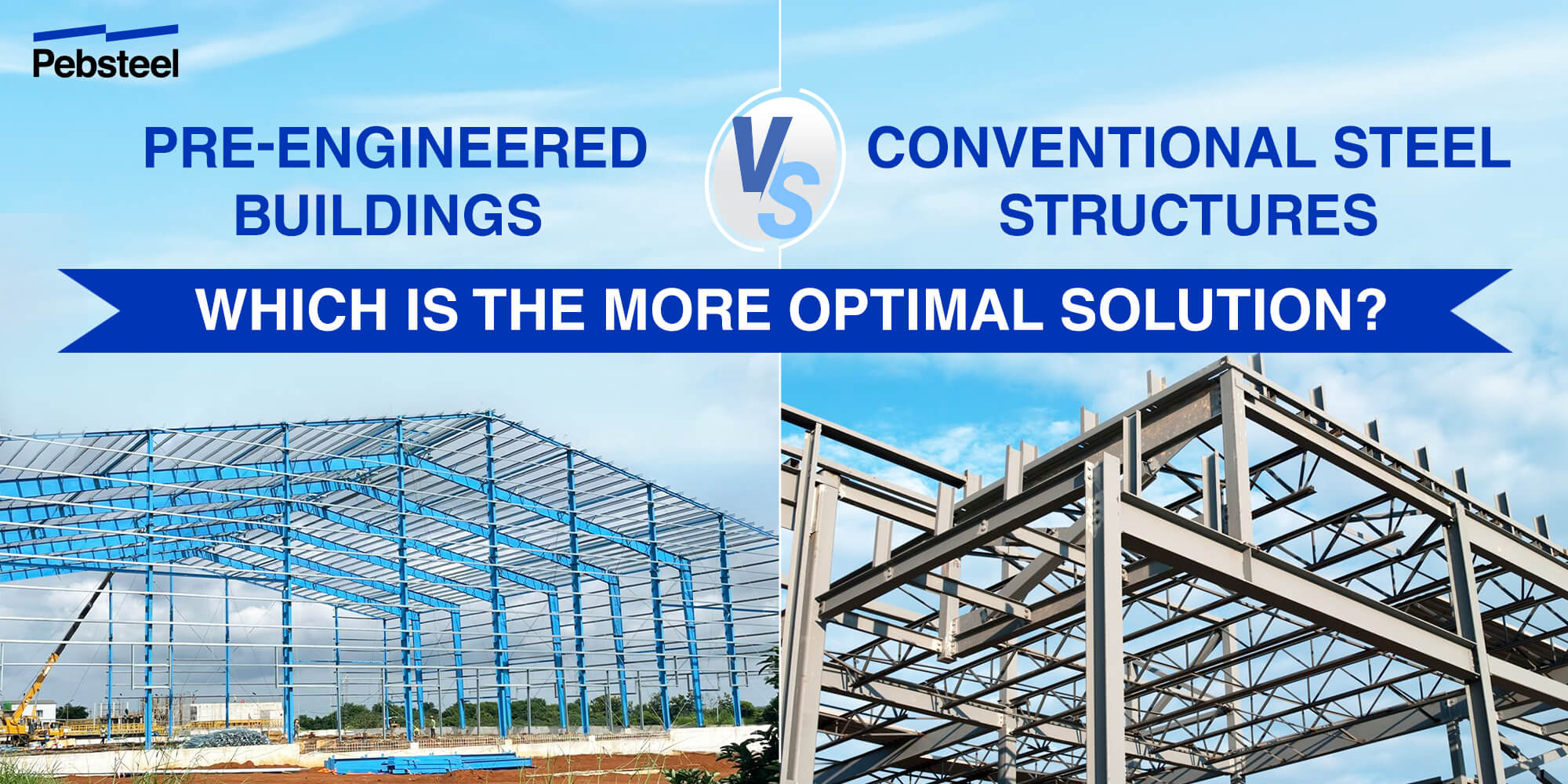
✅ Structural feasibility assessment — span options, load assumptions, system comparison (PEB vs conventional)
✅ Section selection & standard compliance review — AISC, EN, AS 4100, SBC, TCVN, SNI
✅ Indicative budget pricing — total installed cost basis, not just material cost per tonne
✅ Factory audit information — EN 1090 fabrication certification, third-party inspection records, project references
→ Request a Technical Consultation — No obligation. Typical response within 1 business day.
Or email the technical team directly at: marketing@pebsteel.com.vn
Disclamer: The content provided in this article is for reference purposes only. For further details or clarification based on your needs, please contact Pebsteel directly.