
Steel beam selection is one of those decisions that looks straightforward until it isn’t. For small residential projects, choosing a standard I-beam from a local stockist might be perfectly adequate. But for a 40,000 m² distribution centre, a multi-bay manufacturing plant, or a high-clearance aviation hangar, the decision involves structural codes, international mill standards, fabrication tolerances, logistics lead times, and long-term total cost — and getting any of these wrong is expensive.
This guide is written for the people who sit with those decisions: procurement managers, EPC contractors, project developers, and structural consultants sourcing steel for industrial, commercial, and institutional projects globally.
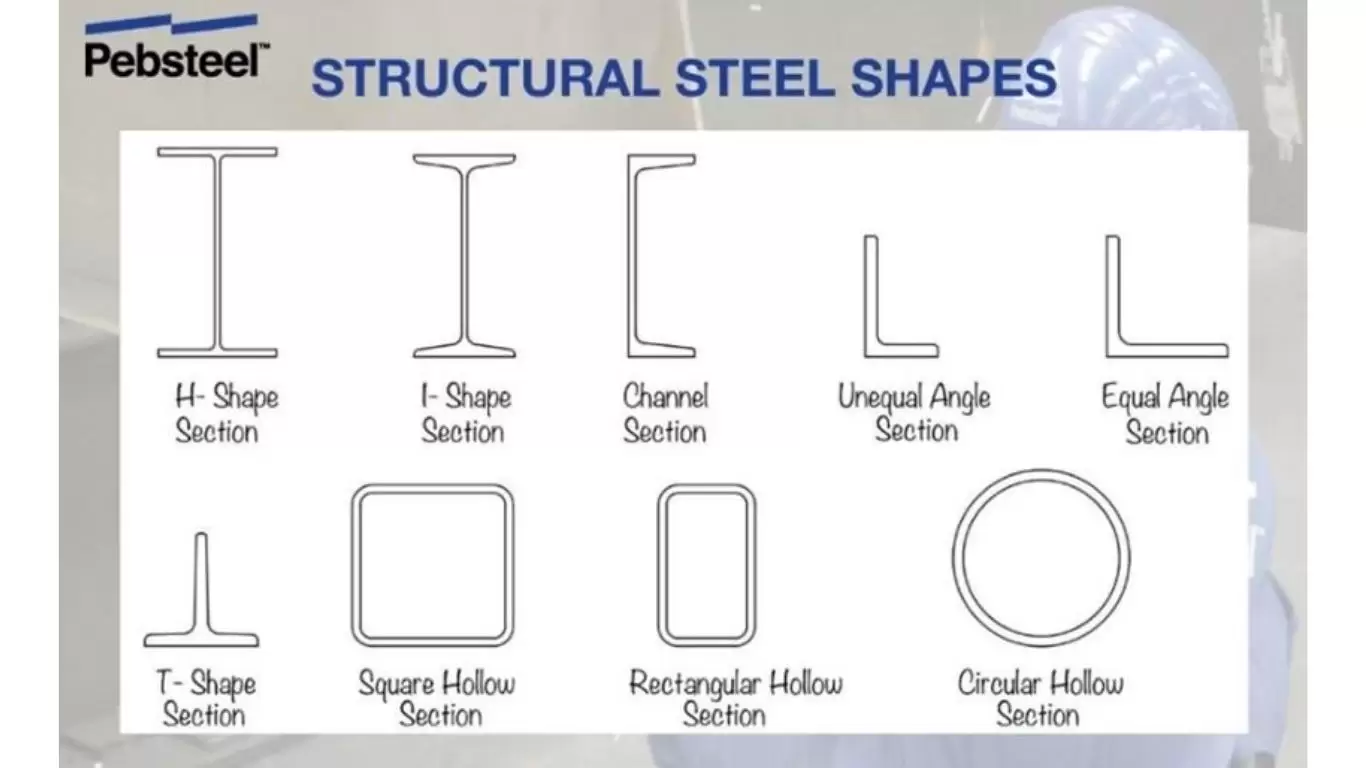
1. What Is a Steel Beam — And Why Its Role Matters Beyond Definition
A steel beam is a structural member designed to resist loads primarily through bending. But that functional definition underplays the cascade of engineering and commercial consequences a single beam selection sets in motion.
In a structural frame, the beam carries gravity loads (dead load + live load + imposed loads from equipment, cranes, or people) across a horizontal span and transfers those loads into vertical columns. The beam’s geometry — its depth, flange width, web thickness — determines how efficiently it performs this function and how well it resists not just bending, but shear, lateral-torsional buckling, and in dynamic environments, fatigue.
For B2B buyers, the critical insight is this: the steel beam is never a standalone product decision. The beam profile affects connection design (which affects fabrication cost), column sizing (which affects foundation cost), building weight (which affects transport and erection), and ultimately the cost per usable square metre of the completed facility. Understanding that chain of consequence is what separates a value-driven procurement from a purely price-driven one.
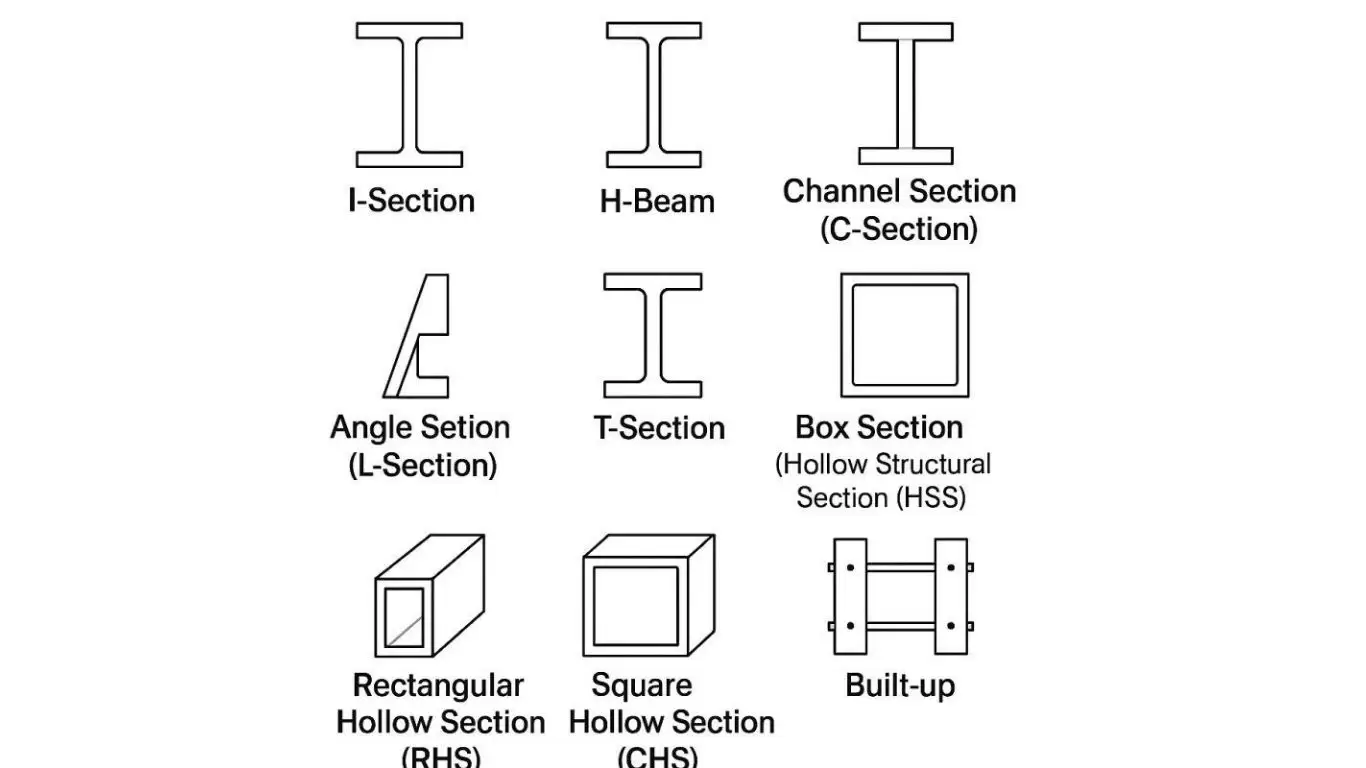
2. The 7 Types of Steel Beams: Technical Profiles and B2B Application Context
Wide Flange Beams (W-Beams / H-Beams)
Wide flange beams are defined by their parallel flanges and uniform thickness throughout. When viewed in cross-section, they resemble a capital H — hence the H-beam designation widely used in Asia — or a broad letter I. This geometry distributes material away from the neutral axis, maximising bending resistance for a given weight of steel.
In North America, these sections follow the ASTM A992 standard (building frames) or ASTM A572 Grade 50 (general structures) and are designated by depth and weight per linear foot: W610×155 indicates a 610 mm nominal depth section weighing 155 kg/m. In Europe, the equivalent HEA, HEB, and HEM series (EN 10034) covers the same structural function, while in Japan and Southeast Asia the JIS H-beam (JIS G3192) is the common reference.
B2B application: Primary frame rafters and columns in pre-engineered metal buildings; heavy-load mezzanine girders; transfer beams above open retail areas; multi-storey commercial frames; industrial platforms supporting heavy equipment.
Procurement note: Confirm whether your design calls for hot-rolled mill sections or welded built-up sections. Hot-rolled provides tighter dimensional tolerances and faster availability from stockholders; built-up sections allow variable depth profiles and optimised material distribution for large-span applications.
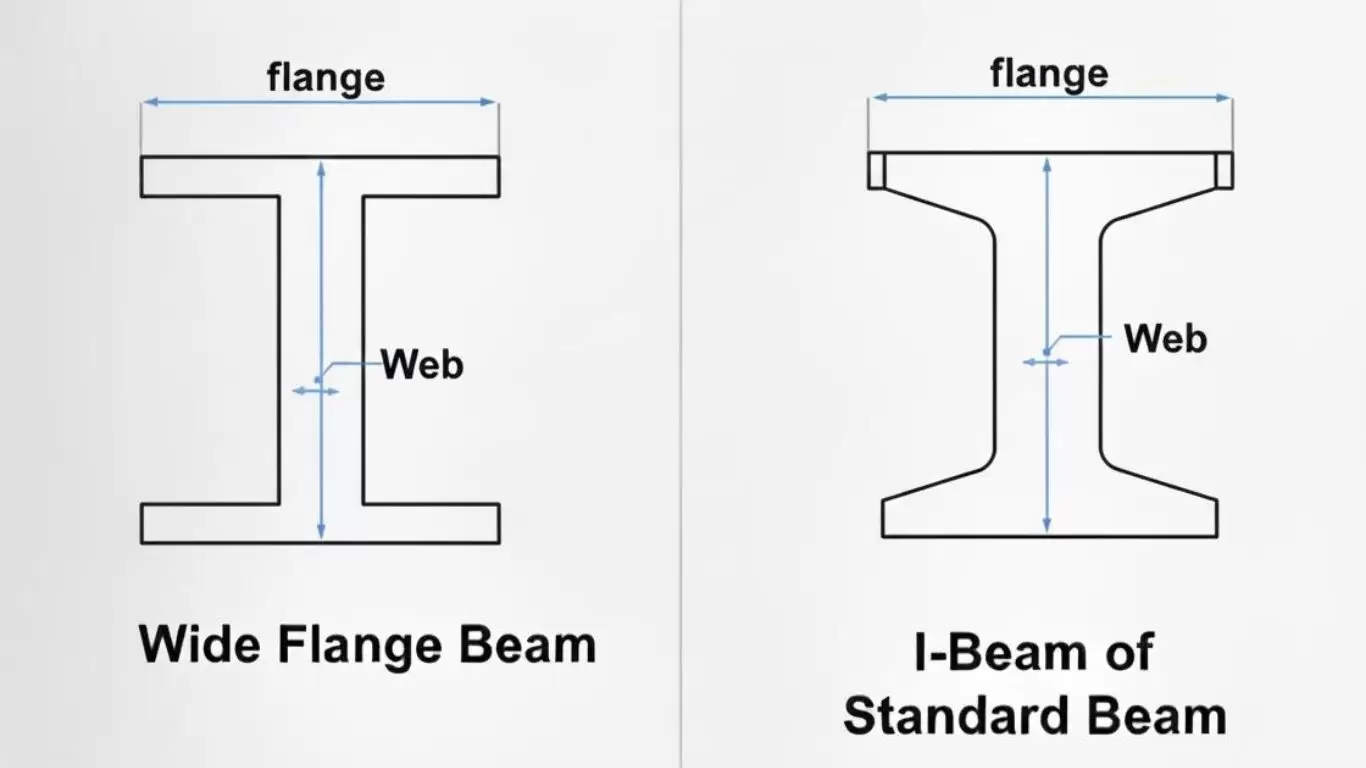
Standard I-Beams (S-Beams / IPE Sections)
Standard I-beams — designated S-beams in North America (ASTM A36) or IPE/IPN in Europe (EN 10034) — differ from wide flange beams through their tapered inner flanges, which are thicker at the web junction and thinner at the outer edge. This geometry is less efficient for modern bolted connections requiring flat bearing surfaces, which is why wide flange profiles have largely displaced S-beams in primary structural roles.
B2B application: Secondary beams in floor framing systems; lintels above door and window openings; crane bridge girders in light-duty duty cycles; renovation and fit-out where matching legacy section dimensions is required.
Tapered Built-Up Beams (Fabricated Plate Girders for PEB Systems)
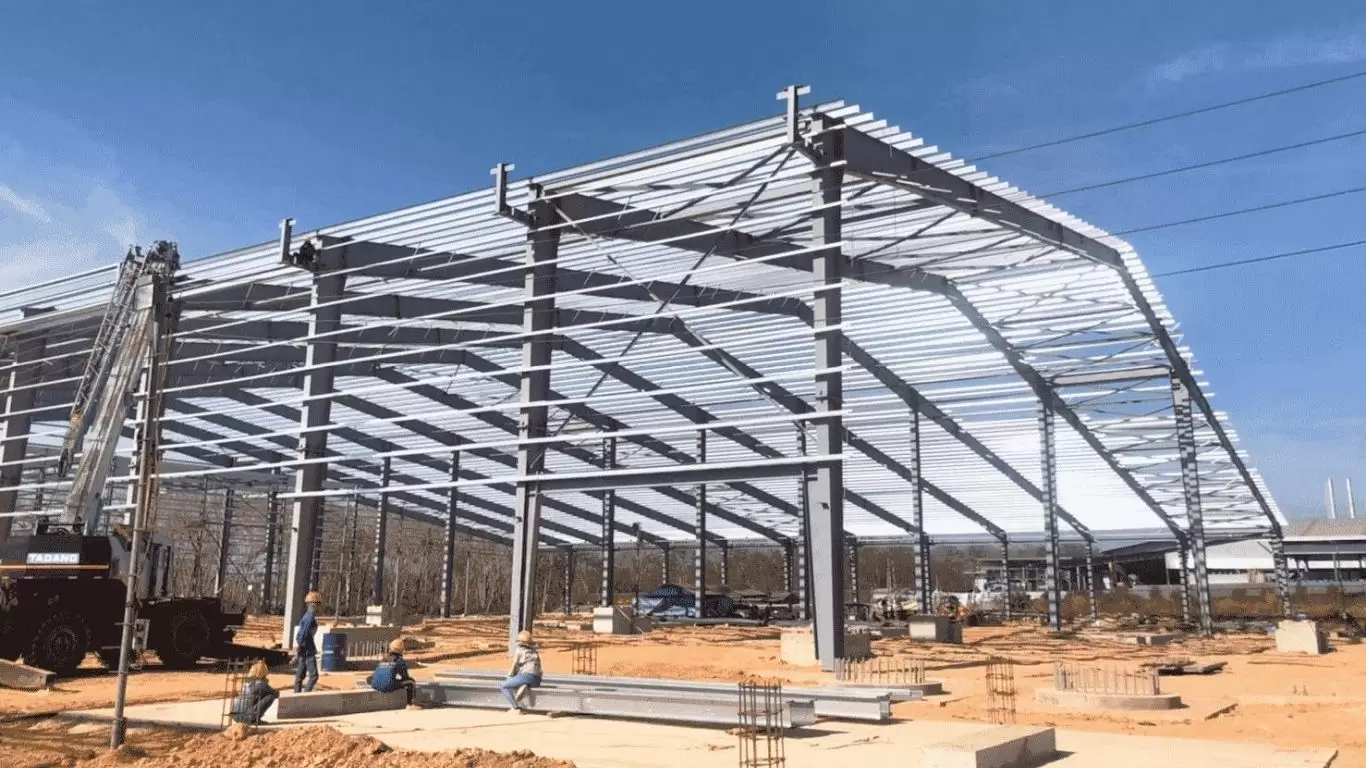
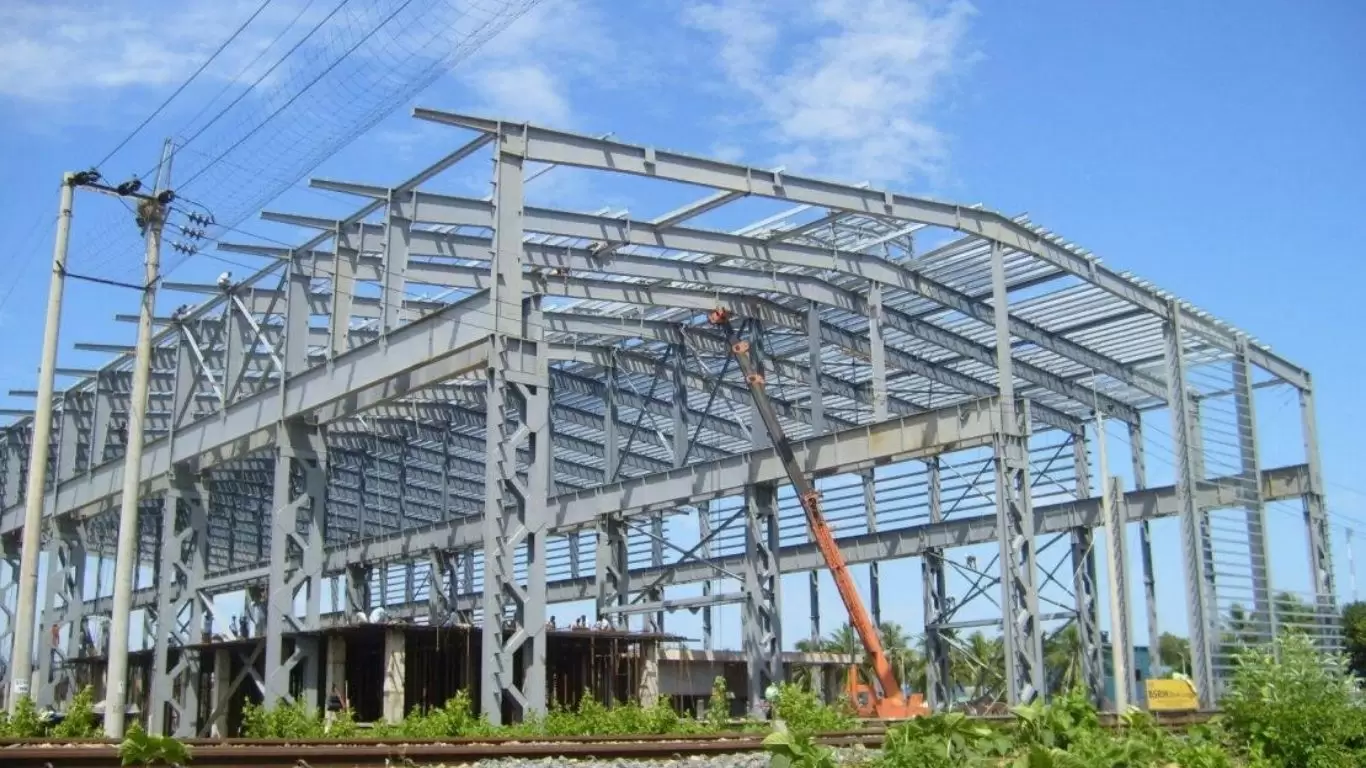
Tapered beams — welded from three steel plates (two flanges and one web) into a variable-depth I-section — are the defining structural element of pre-engineered building (PEB) systems. By varying the section depth along the beam’s length, fabricators concentrate material only where bending moments are highest, typically at the haunch connections at the column top and at mid-span for gravity loads.
For portal frame structures spanning 30–90 m, tapered rafters can reduce total steel weight by 15–30% compared to equivalent prismatic hot-rolled sections. This material efficiency is the primary structural reason why purpose-designed PEB systems consistently deliver lower cost per square metre than conventionally designed steel buildings at equivalent spans.
B2B application: This is the standard primary frame beam in any PEMB procurement. If you are sourcing a complete building solution — as opposed to loose steel sections — tapered built-up beams will form the primary frame.
Quality specification point: Specify weld qualification to AISC or EN 1090 Class EXC2 (minimum) for primary frame welds. Require ultrasonic testing (UT) records for web-to-flange fillet welds, and demand shop inspection access rights to verify dimensional compliance and surface preparation quality before shipment.
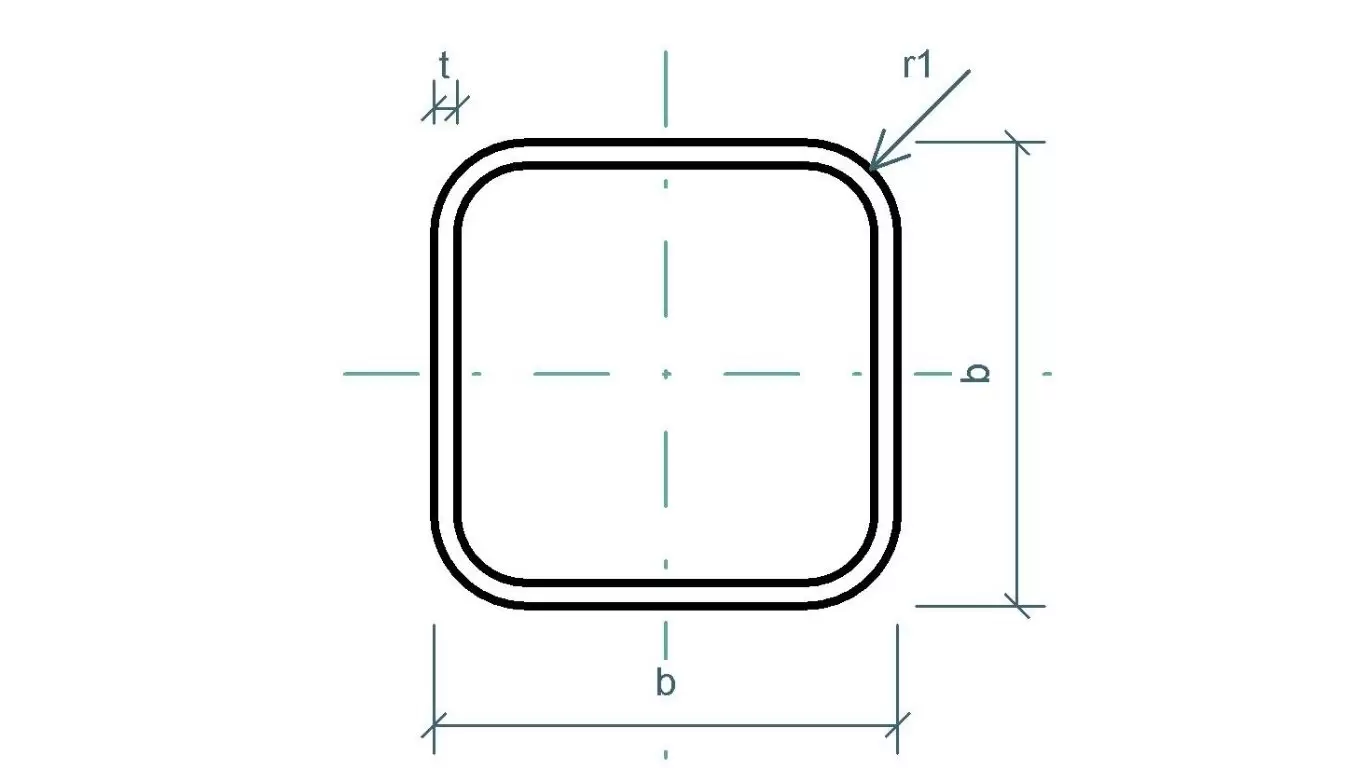
Box Beams (Hollow Structural Sections — HSS / RHS / SHS)
Box beams are closed hollow sections in rectangular (RHS), square (SHS), or circular (CHS) form. Their closed geometry provides dramatically superior torsional resistance compared to open sections — a property that becomes critical when beams are loaded off-axis, cantilevered, or used in architecturally exposed applications.
Standards governing these sections include ASTM A500 (North America), EN 10219 (Europe for cold-formed), and EN 10210 (hot-formed). Section sizes range from 50×50 mm for light secondary steelwork to 400×400 mm and above for heavy transfer beams.
B2B application: Canopy framing at logistics docks and drive-through steel structures; architecturally exposed column and beam grids in commercial lobbies; mezzanine edge beams subject to eccentric loading; aviation hangar frames where aesthetic exposure is a client requirement.
T-Beams and WT Sections
Structural T-sections (designated WT in the AISC tables) are produced by longitudinally splitting a wide flange beam, yielding a section with one flange and a projecting web — a capital T in cross-section.
B2B application: Truss chord members in long-span roof structures; connection plates and bracing elements; composite floor construction where the top flange of a T-section bonds with a cast-in-place concrete slab via headed shear studs.
Channel Sections (C-Channels / Parallel Flange Channels)
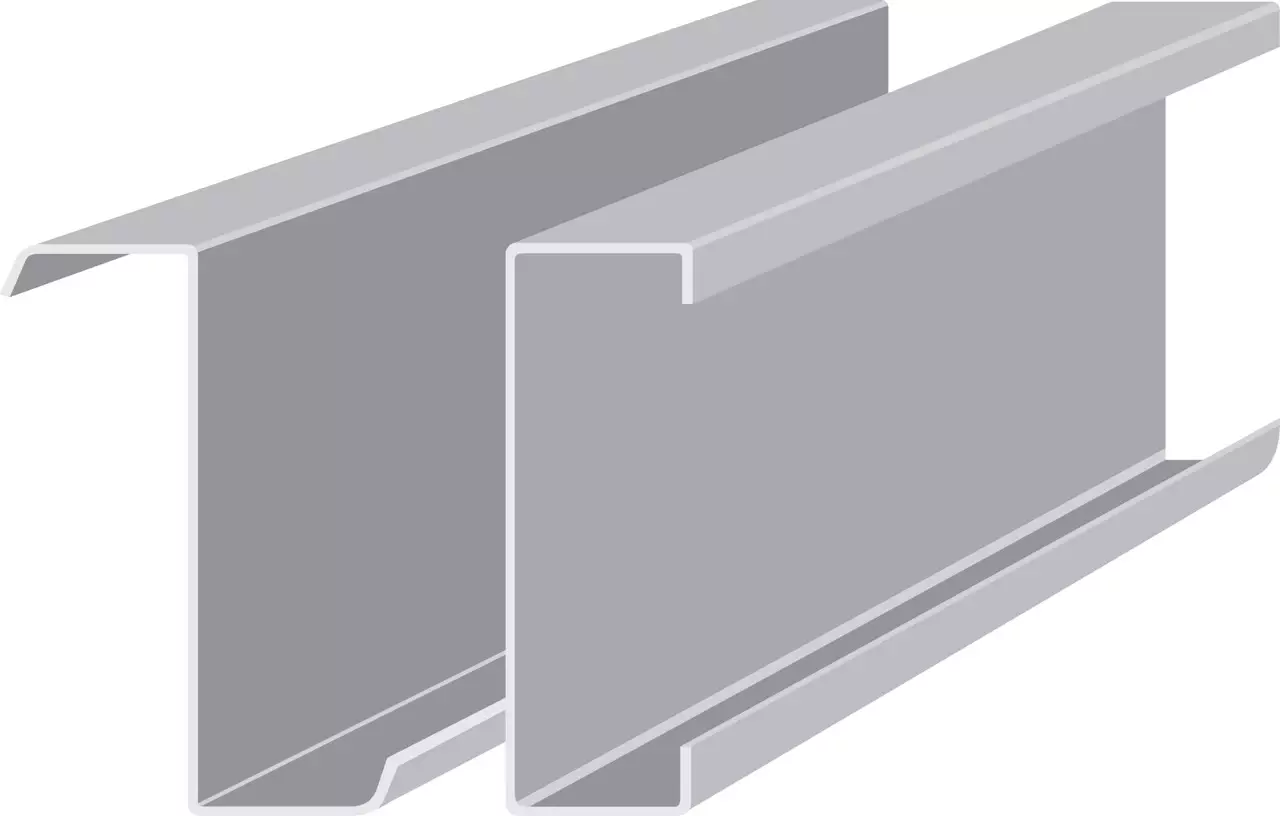
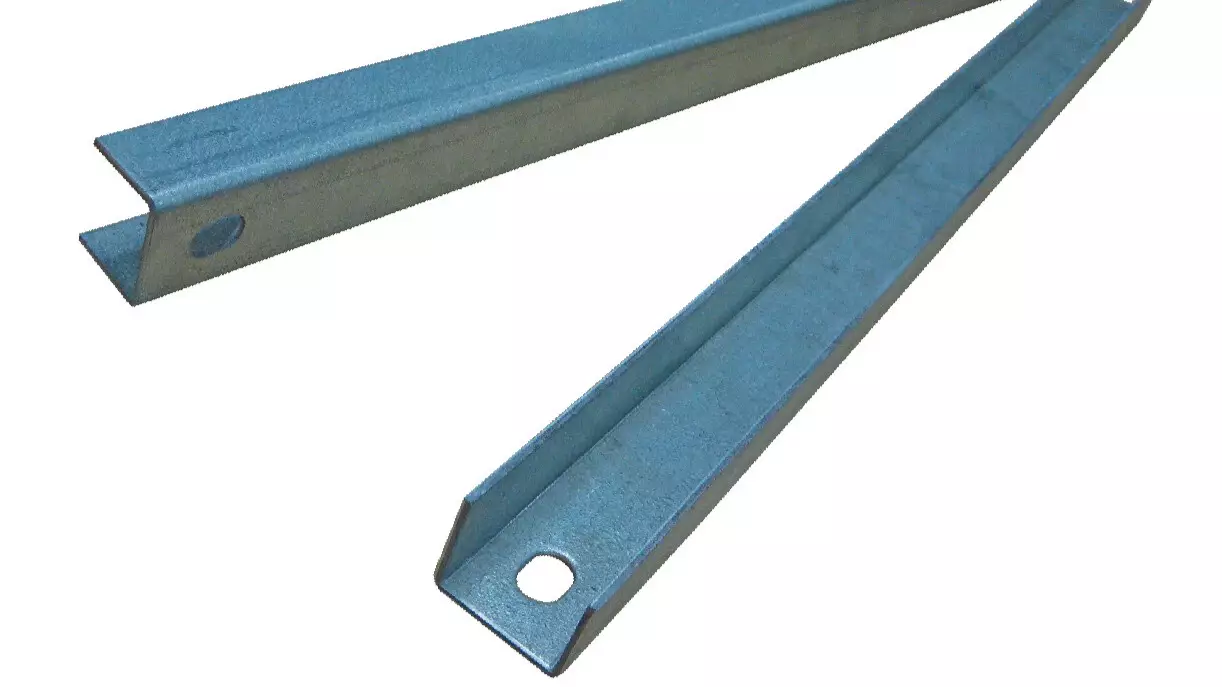
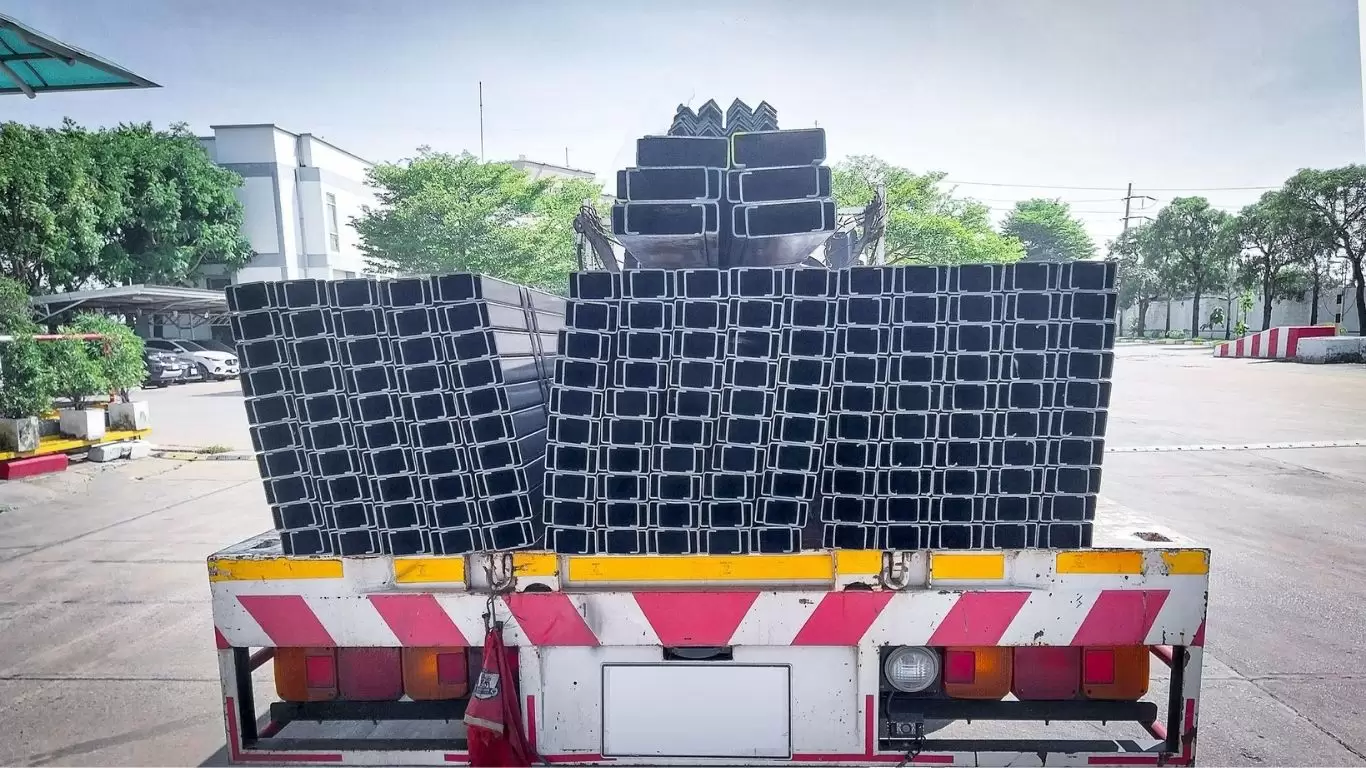
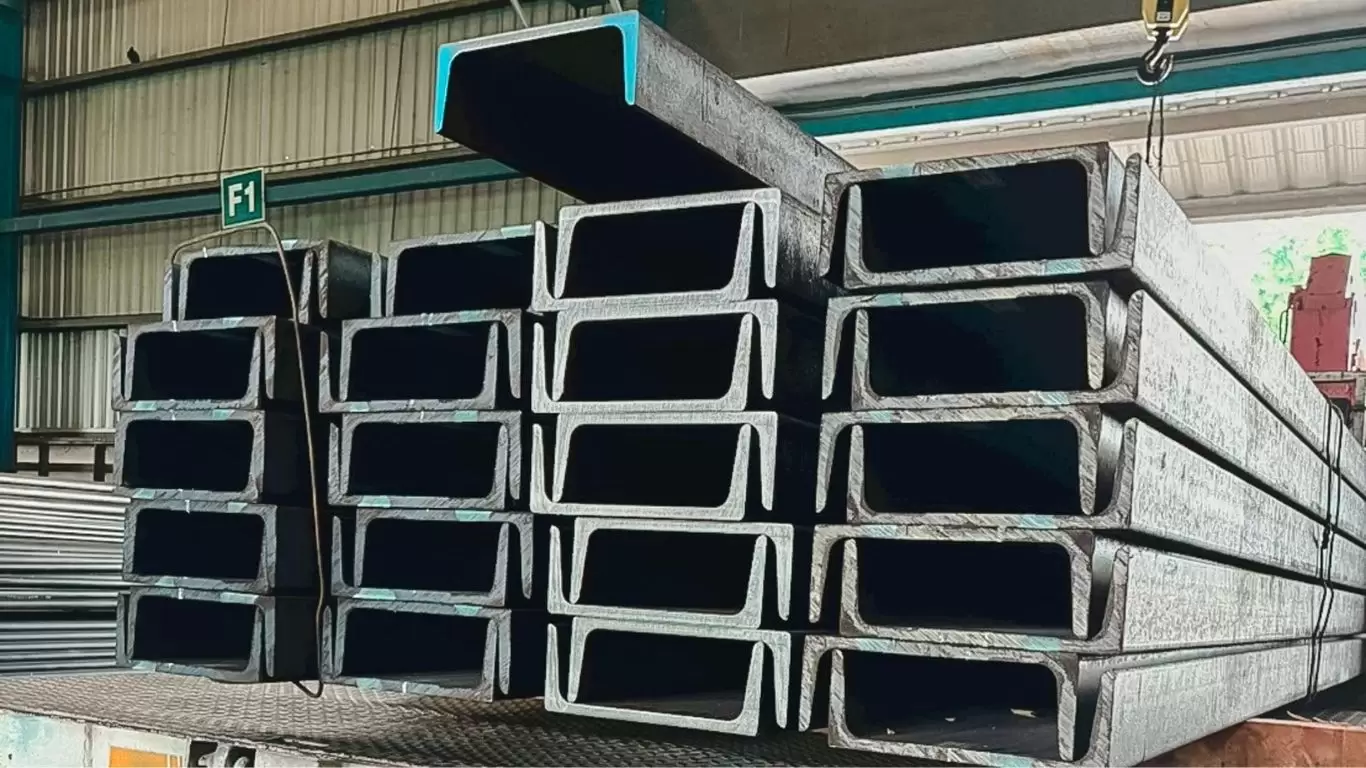
Channel sections — C-shaped in cross-section with a web and two flanges on one side — are among the lightest structural steel profiles available. Their eccentric shear centre (located outside the section boundary) means they must be braced against torsion when used in primary bending roles, but this constraint is rarely relevant in their most common applications.
B2B application: Cold-formed Z and C sections have largely replaced hot-rolled channels as purlins and girts in modern PEB cladding systems. Hot-rolled channels remain common as crane rails supports, secondary framing members, and edge trim elements in structural packages.
Crane Runway Beams (Plate Girders for Overhead Crane Systems)
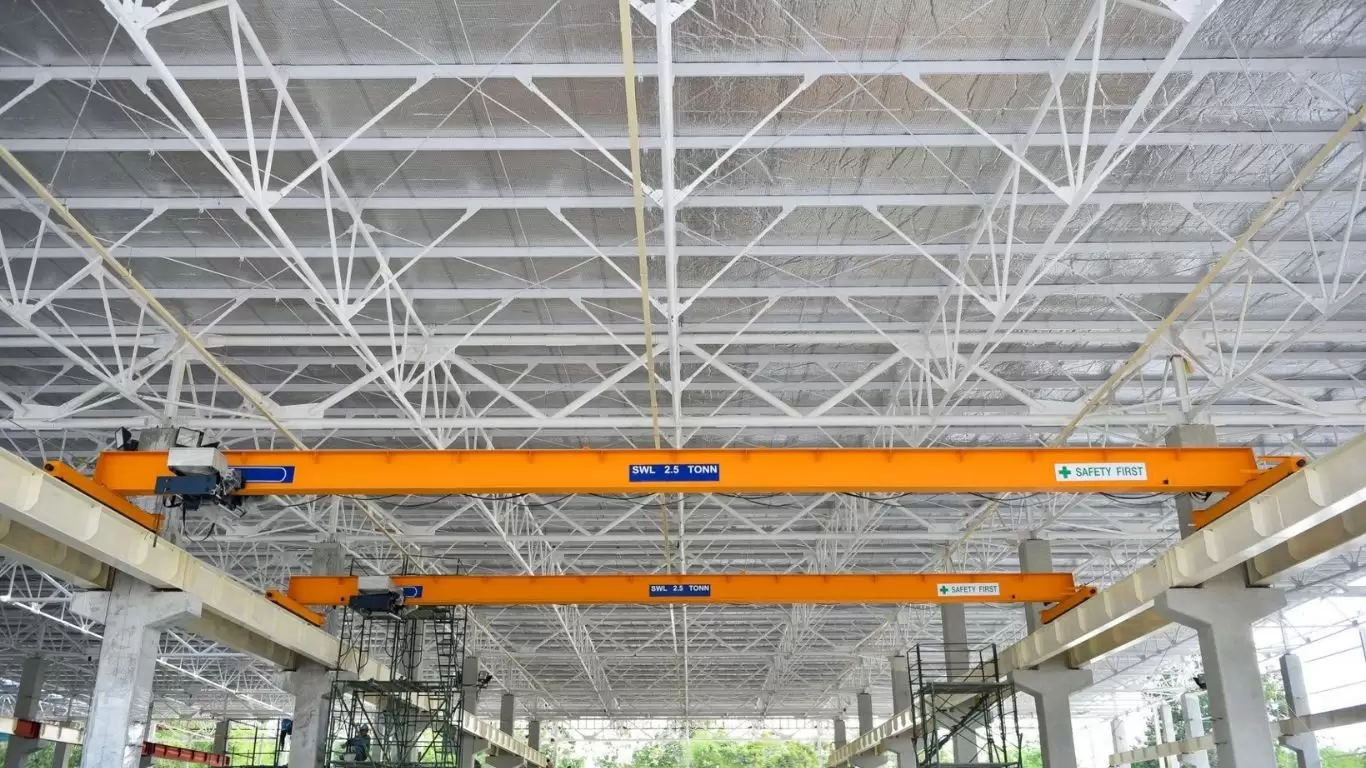
Crane runway beams are a specialised, high-fatigue application that deserves separate treatment. These are typically fabricated plate girders designed to support repeated wheel loads from overhead travelling cranes — a combination of vertical, horizontal, and impact loading that creates a fatigue stress environment fundamentally different from static gravity loading.
Design must follow fatigue provisions in AISC or FEM 1.001 (European crane loading standard), and the beam must be aligned with the crane supplier’s wheel gauge, wheel load, and rail size specifications. A cap channel is typically welded to the top flange to receive the crane rail.
B2B application: Manufacturing plants incorporating overhead bridge cranes (5 to 100+ tonne capacity); logistics and distribution facilities with stacker cranes; process plants with maintenance lifting requirements.
Critical coordination point: Crane runway beam procurement must be fully coordinated with crane supplier data before beam design is finalised. Scope gap errors at this interface — where the building supplier and crane supplier each assume the other has covered the runway beam — are a documented source of significant project cost overruns.
3. Global Standards for Steel Beams: ASTM, EN, JIS, and GB Compared
International B2B procurement in structural steel is complicated by the coexistence of multiple regional standard families. A project in Southeast Asia may reference ASTM for structural grades while using JIS for section geometry and EN for weld quality. Understanding the core differences prevents substitution errors that can compromise structural performance or create contractual disputes.
| Standard | Region | Typical Grades | Min Yield Strength | Key Use Case |
|---|---|---|---|---|
| ASTM A992 | North America | Gr. 50 | 345 MPa | W-shapes in building frames |
| ASTM A36 | North America | — | 250 MPa | General structural carbon steel |
| ASTM A572 Gr.50 | North America | Gr. 50 | 345 MPa | High-strength plates and shapes |
| EN 10025 S235 | Europe | S235JR/J0/J2 | 235 MPa | Light structural applications |
| EN 10025 S355 | Europe | S355JR/J0/J2/K2 | 355 MPa | Primary structural frames |
| JIS G3101 SS400 | Japan/Asia | SS400 | 245 MPa | General structural; common in SEA |
| JIS G3106 SM490 | Japan/Asia | SM490 | 325 MPa | Weldable structural, bridges |
| GB/T 700 Q235 | China | Q235B | 235 MPa | Light commercial construction |
| GB/T 1591 Q355 | China | Q355B | 345 MPa | Primary industrial frames |
Procurement rules when comparing standards:
- Rule 1 — Always verify impact toughness (Charpy). S355J2 guarantees impact energy at −20°C; ASTM A572 Gr.50 does not mandate Charpy testing by default. For cold-climate projects or dynamically loaded members, toughness sub-grade is critical.
- Rule 2 — Carbon equivalent (CE) affects weldability. CE = C + Mn/6 + (Cr+Mo+V)/5 + (Ni+Cu)/15. Higher CE requires more stringent preheat and inter-pass temperature control during welding. Standard structural grades typically have CE ≤ 0.43 for good weldability; confirm with the MTC.
- Rule 3 — Require Mill Test Certificates (MTCs) traceable to heat numbers. No MTC = non-conforming material, regardless of claimed standard. MTCs must be issued by the producing mill, not by a trading intermediary, and must match the dimensional and chemical requirements of the specified standard.
- Rule 4 — Section geometry standards are separate from material grade standards. An EN 10034 HEA 300 section in S355 is two separate specifications — the first defines the geometry, the second defines the material. Both must be confirmed in purchase documentation.
4. A B2B Decision Framework for Steel Beam Selection
Beyond identifying beam types, B2B buyers need a repeatable framework for beam selection decisions. The following eight-variable framework structures the process for procurement managers and project teams:
Variable 1: Structural Role in the Load Path
Define whether the beam is a primary element (rafter, girder, transfer beam), secondary element (purlin, girt, joist), or specialised element (crane runway, composite beam). Each role has different design code provisions, deflection limits, and connection details.
Variable 2: Span and Imposed Load
Longer spans and heavier loads require either deeper beams, higher-strength steel, or both. Structural engineers calculate the required moment of inertia (I) and section modulus (S) from first principles. As a buyer, your responsibility is to ensure the loading assumptions in the design match actual operational conditions — including future equipment additions and expansion provisions.
Variable 3: Deflection Serviceability Limits
Building codes specify maximum allowable deflection as a fraction of the span (L). Common limits include L/200 for roofs, L/360 for floors supporting brittle finishes, and L/600 for crane runway beams supporting sensitive crane operations. Deflection — not strength — often governs beam size selection in longer spans.
Variable 4: Connection System
Bolted moment connections require thick flanges; simple shear tab connections allow more flexibility. In seismic design zones (SDC C and above in AISC, or Seismic Performance Category 3 and above in Eurocode 8), moment-frame beams must meet specific compactness criteria and reduced beam section (RBS) or other special detail requirements. Connection design drives up to 30% of fabrication cost.
Variable 5: Environment and Corrosion Protection
Coastal, high-humidity, chemical, or salt-spray environments require hot-dip galvanising (HDG) or multi-coat epoxy/polyurethane systems. HDG adds approximately 10–15% to material cost but eliminates repainting for 20+ years. Specify the coating system in the supply contract with surface preparation standards (Sa 2.5 to ISO 8501-1) and dry film thickness (DFT) requirements, not just a paint colour.
Variable 6: Fire Rating Requirements
Most national building codes mandate fire resistance ratings of 30, 60, or 90 minutes for structural steel in occupied buildings. Options include intumescent paint (thin-film or thick-film), board encasement, concrete encasement, and spray-applied mineral fibre. Intumescent coatings are dominant in new industrial construction; confirm the required rating and approved system before finalising the supply scope.
Variable 7: Lead Time and Critical Path Position
Hot-rolled sections from international mills carry 8–16 week lead times when not available from local stockholders. Fabricated built-up sections for PEB systems typically require 10–18 weeks from signed order to shipment. Steel is almost invariably on the project critical path. Late procurement decisions translate directly into delayed project completions — and for industrial facilities, delayed production or logistics revenue.
Variable 8: Total Cost of Ownership
Evaluate steel beam cost not just as purchase price per tonne, but as a contribution to total installed cost across five dimensions:
- Superstructure material cost (per tonne of steel)
- Foundation cost (heavier frames increase column reactions and footing size)
- Erection cost (heavier or more complex connections slow field assembly)
- Maintenance cost over 25 years (surface treatment quality determines repaint cycle frequency)
- Adaptability value (can the frame accommodate future crane additions, bay extensions, or occupancy changes without complete replacement?)
A well-optimised PEB system may cost 5–12% more in material per tonne than generic hot-rolled sections, yet deliver 15–25% lower total installed cost when all five dimensions are evaluated — particularly for clear-span buildings above 20 m.

5. Steel Beams in Pre-Engineered Metal Buildings: What B2B Buyers Need to Know
Pre-engineered metal buildings (PEMBs) represent the highest level of integration in structural steel design and procurement. Rather than sourcing loose sections and engaging separate engineering, detailing, and fabrication services, a PEMB system delivers an optimised, pre-fabricated building frame — beams, columns, purlins, girts, bracing, cladding connections, and all hardware — from a single supply chain.
The defining structural element in a PEMB is the tapered built-up rafter, described earlier. PEB manufacturers design these using certified structural software, optimising every beam cross-section along the portal frame to minimise steel tonnage while meeting all strength, deflection, and stability code requirements. The result is a highly material-efficient structure that also arrives at site pre-fabricated, pre-drilled, and fitting-marked for rapid erection.
Why this procurement model matters for B2B buyers:
- Single-source design responsibility. The PEB manufacturer holds structural design liability. In a conventional project, errors at the interface between engineer, fabricator, and erector are a documented and expensive source of claims and disputes. A single-source PEMB contract eliminates most of these interfaces.
- Predictable schedule. Factory manufacturing eliminates weather dependence and site constraints during fabrication. A 15,000 m² warehouse frame can typically be shipped in a coordinated sequence and erected in 6–10 weeks — a timeline that is difficult to match with site-welded conventional construction.
- Design flexibility within standardised efficiency. Modern PEB systems span up to 90 m clear, accommodate multiple cranes up to 50+ tonnes, incorporate mezzanines and lean-to bays, and can be engineered to meet seismic zone requirements including AISC 341 Seismic Provisions. The system is not a cookie-cutter solution — it is an optimised one.
- Scalability. Reputable PEB manufacturers have delivered buildings from 500 m² to 200,000+ m² within the same quality system. The engineering and detailing overhead that would make a conventional approach cost-prohibitive at small scale, or insufficiently optimised at large scale, is absorbed within the PEB system’s standardised design platform.
6. Sustainability and ESG in Steel Beam Procurement
Environmental, Social, and Governance (ESG) criteria are reshaping procurement decisions across industrial and commercial construction globally. Structural steel — and steel beams in particular — have a nuanced sustainability profile that informed B2B buyers should understand.
Steel’s environmental advantages:
Steel is the world’s most recycled material by volume. At end of building life, structural frames can be dismantled and recycled with no degradation of material properties. Electric arc furnace (EAF) production — which dominates new capacity investment globally — produces structural sections with 60–95% recycled content, a carbon intensity significantly lower than blast furnace production.
Lighter, optimised steel frames (such as those produced through PEB design) require smaller foundations, reducing concrete volume and embodied carbon in the substructure — a component that is difficult to decarbonise and rarely accounted for in simplified carbon comparisons.
Steel buildings are inherently adaptable: spans can be extended by adding bays; heights can be increased; crane loadings can be upgraded. This adaptability extends building service life and avoids the embodied carbon cost of demolition and reconstruction.
What to request from suppliers:
- Environmental Product Declarations (EPDs) per ISO 14025, certifying the Global Warming Potential (GWP) in kg CO₂e per tonne of structural steel sections — ideally plant-specific rather than industry-average.
- Recycled content certificates for sections produced by EAF route.
- Coating system VOC compliance documentation for applied paint systems.
- Waste management plans from the fabrication facility, documenting steel offcut recycling rates.
As LEED v4.1, BREEAM 2018, and IFC Performance Standards increasingly require documented environmental data from structural material suppliers, the ability to provide this data is becoming a de facto pre-qualification requirement in institutional, multinational, and government-funded projects.
7. Steel Beam Quality Assurance: A Procurement Checklist
For B2B buyers sourcing structural steel internationally — whether hot-rolled sections, fabricated plate girders, or complete PEB frame packages — the following quality requirements should be non-negotiable in supply contracts:
- Mill Traceability Every structural steel section must be traceable to a mill heat number, with full Mill Test Certificates available for project record. MTCs must certify chemical composition and mechanical properties (yield strength, tensile strength, elongation, and impact energy where specified) against the governing standard. No MTC, no acceptance.
- Dimensional Inspection Receive inspection at the fabrication shop should verify section dimensions against the shop drawings, including depth, flange width, web thickness, flange thickness, and straightness within permitted tolerances (AISC Code of Standard Practice or EN 1090 as applicable).
- Weld Inspection For fabricated sections, require weld procedure specifications (WPS) qualified to AWS D1.1 or EN ISO 15614, and welder qualification records. For primary frame welds, specify non-destructive testing (NDT) — ultrasonic testing (UT) for full-penetration groove welds, and magnetic particle inspection (MPI) for fillet welds in high-stress regions.
- Surface Preparation and Coating Specify surface preparation to Sa 2.5 (near-white blast) per ISO 8501-1 minimum for primary structural members receiving paint. Verify dry film thickness (DFT) of each coat against specification using calibrated thickness gauges. Require adhesion test records (cross-hatch or pull-off) for each coating application batch.
- Third-Party Inspection For projects above a threshold value — typically USD 2 million in steel supply — consider engaging an independent third-party inspection (TPI) agency at the fabrication facility prior to shipment. TPI provides an independent verification of dimensional compliance, weld quality, and surface treatment that protects the buyer when relying on a supplier located in a different country or jurisdiction.
- Documentation Package A compliant steel supply should deliver: fabrication drawings (approved for construction), material certificates, weld procedure records, NDT reports, coating records, packing lists, and country of origin declarations. This documentation is essential not just for quality assurance but for customs clearance, project handover records, and potential future insurance or litigation matters.
8. How to Evaluate a Global Steel Beam Supplier: B2B Qualification Criteria
Not every supplier capable of producing structural steel can reliably execute a large-scale industrial steel supply on schedule, on specification, and with full quality documentation. Use the following criteria to pre-qualify suppliers before issuing tender documents:
- Technical capability: Does the supplier have certified structural engineering capacity (professional engineer sign-off or equivalent) for the design scope required? For PEB systems, is the design software certified or independently validated?
- Quality system: Is the supplier certified to ISO 9001? For welded structural steel in Europe and European-funded projects, does the supplier hold EN 1090 EXC2 (or higher) execution class certification?
- Production capacity and scheduling: What is the supplier’s current backlog and realistic throughput for your required tonnage within your required schedule? Request references for comparable project sizes and schedules.
- International experience: Has the supplier delivered to your project’s destination country before? Are they familiar with local customs requirements, import documentation, and any country-specific technical approval processes?
- Financial stability: For supply contracts above USD 1 million, a basic credit assessment and review of audited financials is reasonable due diligence. A supplier that becomes financially distressed mid-project creates a project-threatening procurement crisis.
- After-delivery support: For PEB systems, does the supplier provide erection manuals, trained erection supervisors, and technical support during the construction phase? Post-delivery support is a meaningful differentiator in complex structural packages.
9. Steel Beam Applications: Industry Sector Reference Guide
To consolidate the technical content above into practical application context, the following sector-by-sector summary maps beam types to industrial and commercial building applications:
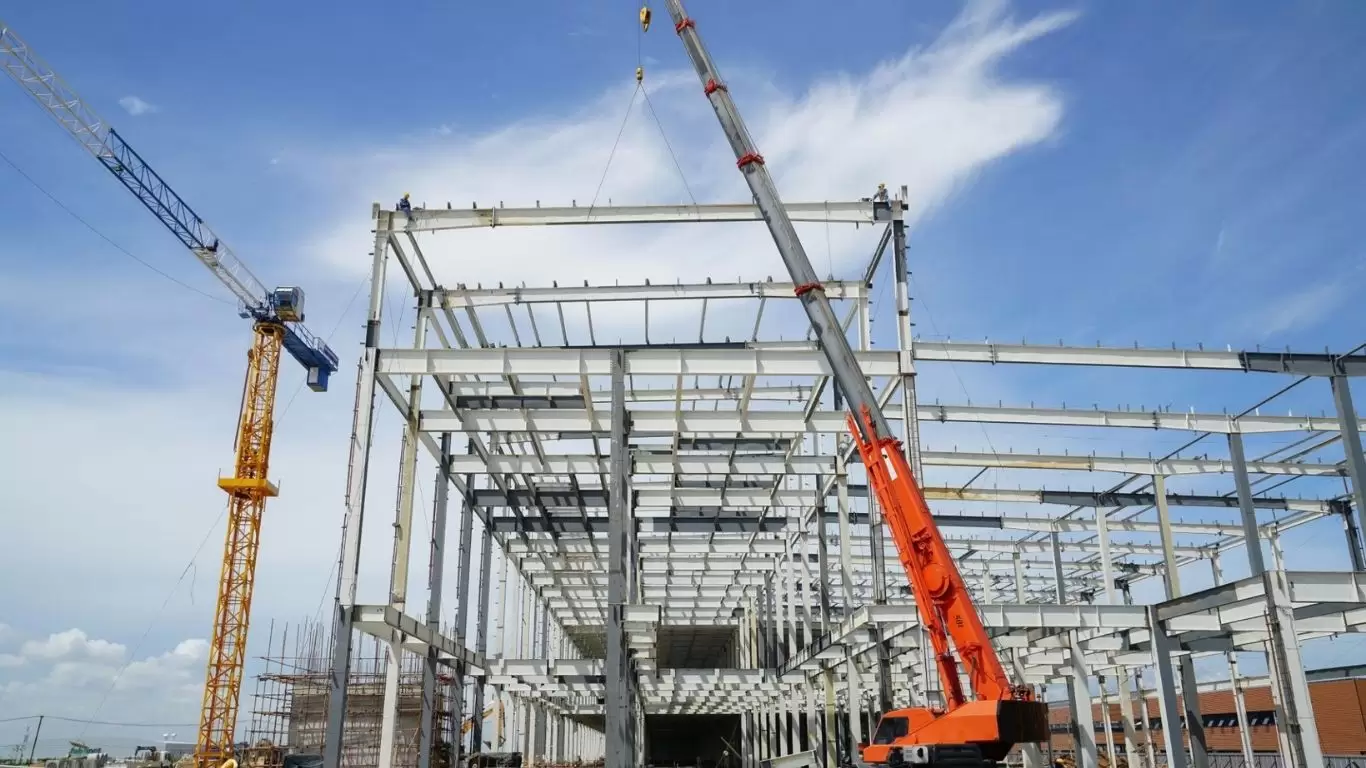
- Distribution and Logistics Centres: Primary frames — tapered built-up wide flange rafters spanning 30–60 m; secondary frames — cold-formed Z/C purlins and girts; dock canopies — RHS box sections; mezzanine floors — hot-rolled wide flange floor beams with composite deck.
- Manufacturing Plants: Primary frames — tapered or prismatic wide flange; crane runway beams — fabricated plate girders per fatigue design; secondary framing — channel sections and cold-formed purlin systems; mezzanine process platforms — wide flange beams with chequered plate.
- Commercial Office and Retail: Multi-storey frames — hot-rolled wide flange or composite slim-floor beams; transfer beams above open ground-floor areas — heavily loaded wide flange or plate girder; podium slabs — composite wide flange with concrete deck.
- Aviation Hangars: Clear spans of 60–100+ m — tapered built-up plate girders or bow-string trusses; secondary roof framing — wide flange purlins; sliding door framing — RHS box sections.
- Data Centres: Raised floor systems — cold-formed channel sections; primary building frame — tapered wide flange in PEB configuration; vibration-sensitive equipment floors — deep wide flange with controlled natural frequency design.
- Cold Storage Facilities: Primary frames — wide flange or tapered in insulated envelope; all structural steel — hot-dip galvanised or epoxy-coated for condensation environment; connections — stainless steel or heavily protected carbon steel fasteners.
10. Working with Pebsteel: Integrated Solutions from a Single Source
For project owners and procurement teams seeking to consolidate the complexity described in this guide, working with an established pre-engineered building manufacturer offers a structured path from design intent to installed structure.
At Pebsteel, primary structural frames use purpose-designed tapered built-up rafters and columns, engineered to AISC and MBMA standards, fabricated to EN 1090 quality provisions, and delivered to project sites across Asia, Africa, the Middle East, and beyond. Each building system is co-engineered with the secondary structure, cladding attachment, and connection system to ensure the steel beam — in every profile and application described in this guide — performs as designed, arrives on schedule, and contributes to a total installed cost that reflects the engineering intelligence built into it.
For project-specific technical advice, structural feasibility studies, or indicative budget pricing, the PEB Steel technical team is available for consultation without obligation.

11. Frequently Asked Questions: Steel Beams for B2B Projects
What is the difference between an I-beam and an H-beam?
I-beams (American Standard or S-beams) have tapered inner flanges that are thicker at the web and thinner at the edges. H-beams (wide flange or W-beams) have parallel flanges of uniform thickness. H-beams provide a larger bearing area for connections, higher torsional stability, and greater load capacity for equivalent weight, making them the dominant choice in primary structural frames. In everyday commercial language, “I-beam” is often used loosely to describe both types — always confirm the section designation to avoid ambiguity in procurement.
How do I specify a steel beam for an international project?
Specify the section designation system (AISC/AISC for North America, EN for Europe, JIS for Japan/Asia), the section geometry code (e.g., W610×155, HEB 300, H400×400×13×21), the material grade standard and grade (e.g., ASTM A992 Gr.50, EN 10025 S355J2), the surface treatment requirement, and the quality documentation package required. Avoid using generic terms like “I-beam in Grade 50 steel” without specifying the applicable standard — this language is ambiguous across different regional conventions.
What is the maximum span for a steel beam in an industrial building?
Hot-rolled wide flange beams are commonly used for spans up to approximately 30 m in simply-supported configurations. For longer spans, fabricated tapered beams in a portal frame configuration can achieve 40–90 m with economic efficiency. Beyond approximately 90 m, truss or space frame systems typically become more cost-effective than solid-web beams. These are general guidelines — actual limits depend on loads, deflection requirements, and local conditions.
How long does it take to procure fabricated steel beams for a large project?
Hot-rolled sections from international mills or regional stockholders: 6–14 weeks depending on availability and logistics. Fabricated built-up sections (tapered rafters, plate girders) from a PEB manufacturer or fabricator: 10–18 weeks from confirmed design and purchase order. Allow additional time for shipping: 3–5 weeks by sea freight for most international routes. Begin procurement as early as the structural design allows — late steel ordering is one of the leading causes of construction schedule overruns in industrial building projects.
Are steel beams suitable for sustainable building certifications such as LEED?
Yes. Structural steel contributes to several LEED v4.1 credits including MR Credit: Building Product Disclosure and Optimization (through EPD submission and recycled content documentation), EA Credit (through building adaptability), and SS Credit (through reduced site disturbance when using a prefabricated PEB system). Work with your steel supplier to obtain EPDs and recycled content certificates early in the project — these documents are required at project submission and cannot be reconstructed after the fact.
Disclamer: The content provided in this article is for reference purposes only. For further details or clarification based on your needs, please contact Pebsteel directly.