
If you need a durable, cost-efficient structure for a warehouse, factory, logistics hub, or commercial facility — a pre-engineered metal building is almost certainly the right answer. Construction timelines are 40–60% faster than reinforced concrete, costs are typically 20–35% lower, and the structural design life exceeds 50 years. This guide covers everything: structural systems, global cost benchmarks, engineering standards by region, corrosion considerations for tropical and coastal climates, and the step-by-step procurement process.
1. What Is a Metal Building?
A metal building — also called a pre-engineered metal building (PEMB), pre-engineered steel building (PESB), or steel building system — is a structure whose primary load-bearing system is factory-fabricated from structural steel components: tapered I-section columns, rafters, cold-formed purlins and girts, and profiled steel cladding panels. All components are designed and produced in a controlled factory environment, then shipped as a complete kit for rapid bolt-up assembly on the project site.
The term ‘metal building’ covers a wide spectrum — from a small agricultural shed to a 200-metre-wide multi-span manufacturing complex. What unites them is the same core principle: engineering-led factory prefabrication that compresses on-site construction time, reduces waste, and delivers a predictable structural outcome.
2. Types of Metal Building Structural Systems
Choosing the correct structural system is the most important early decision in a metal building project. The three principal systems are:
| System | Description | Max Clear Span | Best For |
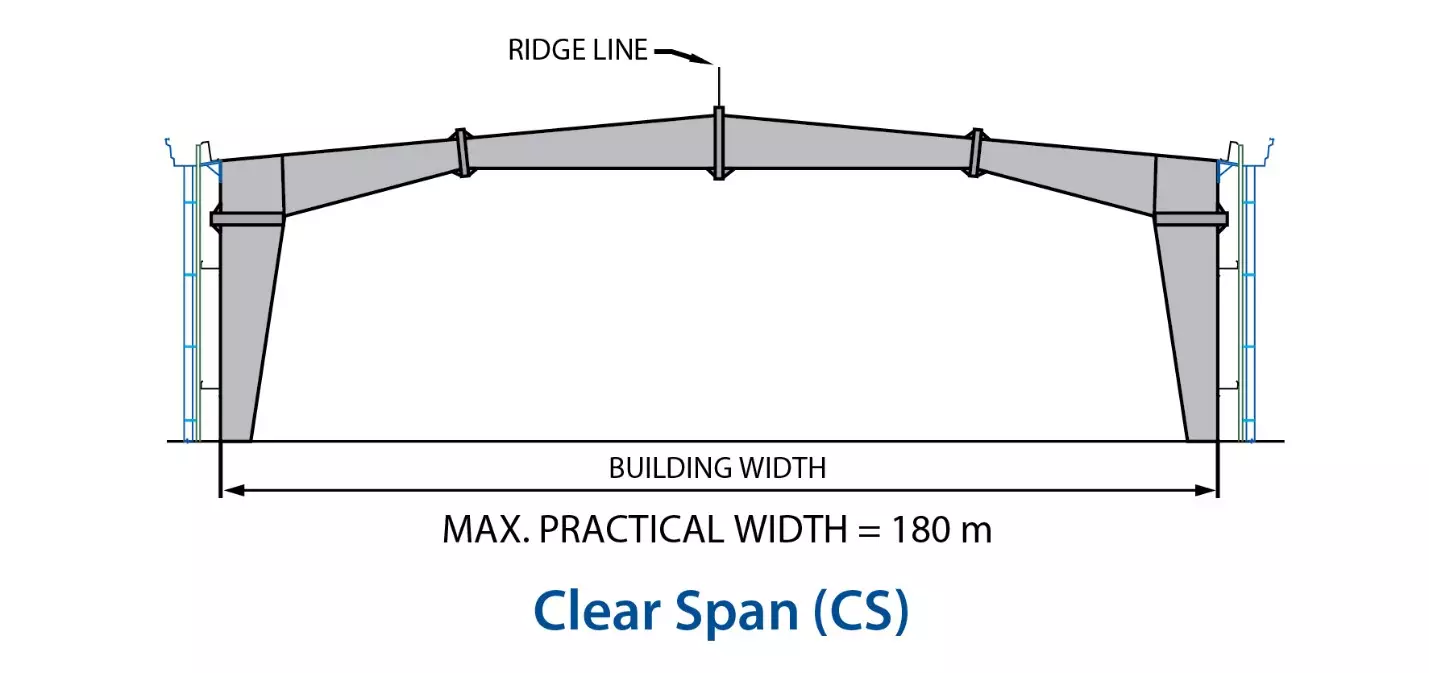
| Clear-Span Rigid Frame | Single-bay frame with no interior columns. Tapered primary rafters and columns carry all loads. | Up to ~90 m | Warehouses, aircraft hangars, sports halls |
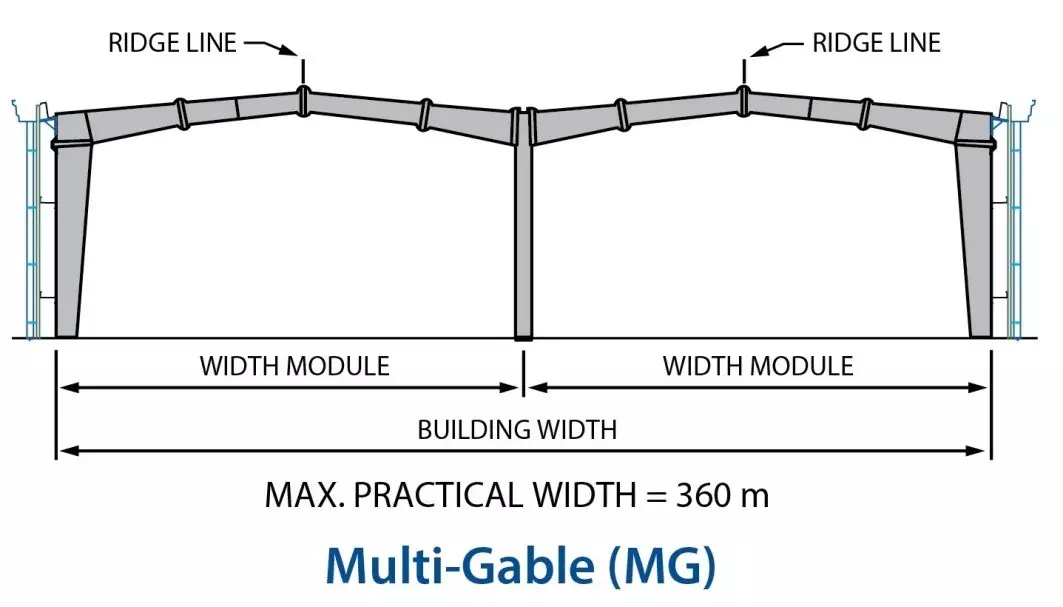
| Multi-Span Frame | Two or more bays with interior columns. Reduces frame weight but interrupts floor space. | Up to 200 m total | Large manufacturing plants, distribution centres |
| Modular / Lean-to | Attached single-slope extension to an existing main frame. Cost-effective for added office or storage space. | Typically <30 m | Office annexes, covered walkways, material storage |
| Single-Slope Frame | One-sided pitched roof. Good for sites with height restrictions on one boundary. | Up to ~60 m | Retail, truck depots, equipment sheds |
Clear-Span vs Multi-Span: How to Choose
The clear-span system maximises usable floor area by eliminating all interior columns — the preferred choice for warehouses requiring wide racking aisles or forklift circulation. Multi-span designs introduce interior columns but dramatically reduce steel tonnage on very wide footprints, cutting both material costs and foundation loads. For spans beyond 60 m, the multi-span system is almost always the more economical choice unless operations genuinely require column-free space.
3. Key Components of a Metal Building
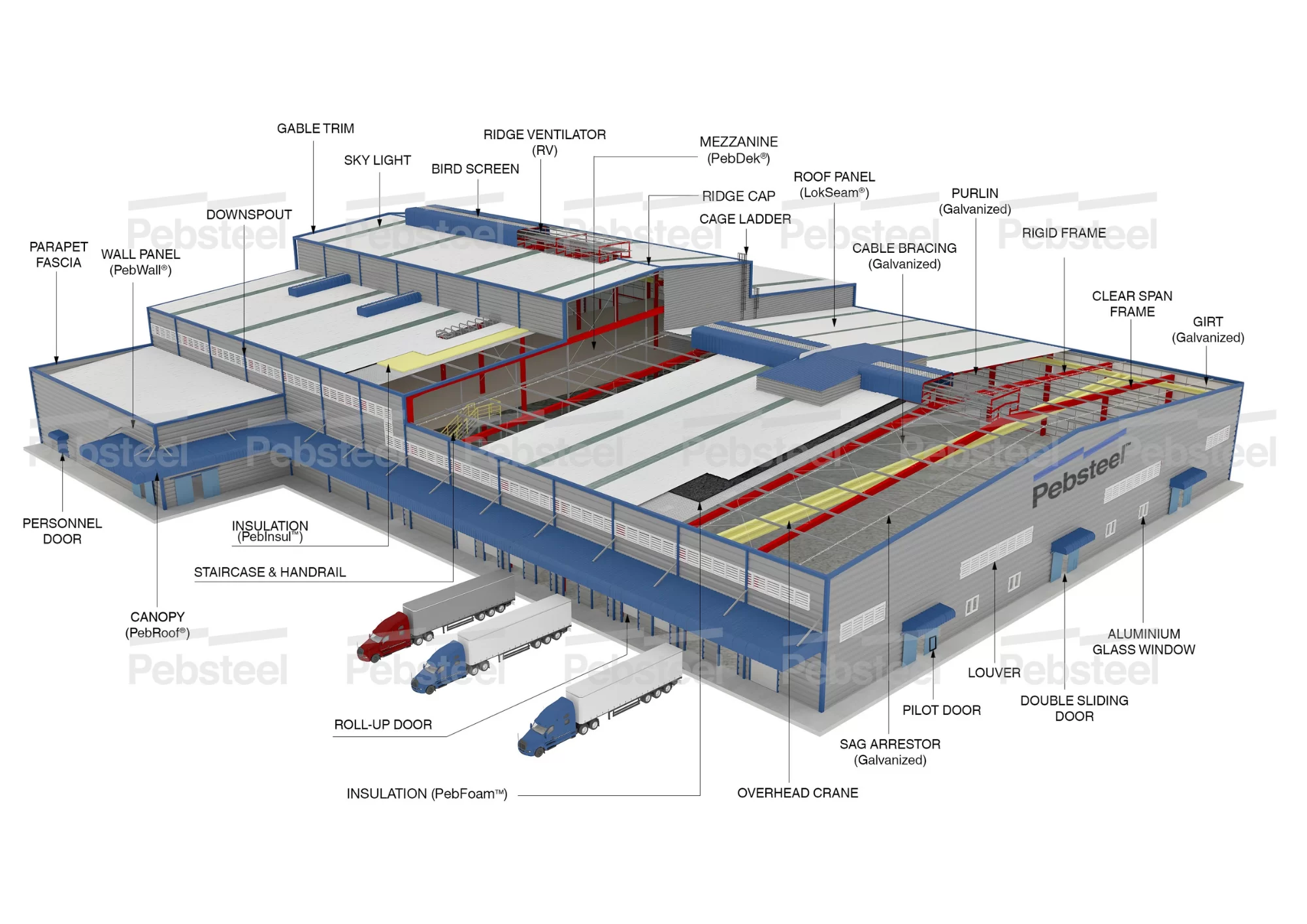
A complete pre-engineered metal building system comprises three structural tiers and a range of accessories:
Primary structural frame: Built-up tapered I-section columns and rafters, welded from high-tensile steel plate (typically ASTM A572 Gr. 50 or equivalent). These carry all gravity and lateral loads to the foundation.
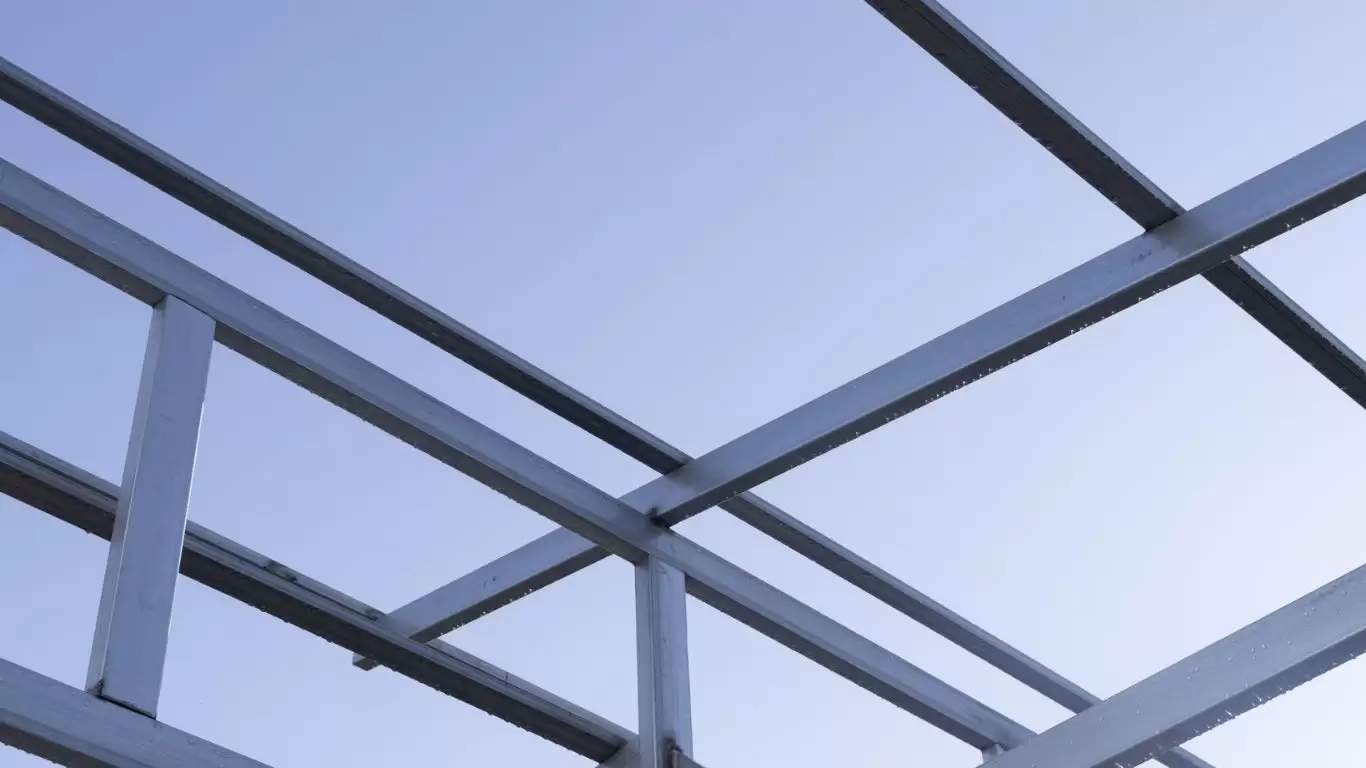
Secondary structural members: Cold-formed Z- or C-section purlins (roof) and girts (walls), typically G550 galvanised steel. They support the cladding and transfer wind loads back into the primary frame.
Roof and wall cladding: Profiled steel sheets — single-skin corrugated, trapezoidal (IBR), or insulated sandwich panels (IMP). Coating options include Zincalume (AZ150), PVDF-painted, or proprietary high-durability systems for aggressive environments.
Accessories: Ridge and eave ventilation, gable and corner trims, gutters and downpipes, framed openings for roller doors, personnel doors, windows, and roof lights. Accessories account for 10–20% of total building cost and have a disproportionate impact on weather-tightness and aesthetics.
READY TO BUILD?
Get a free engineering consultation and itemised quotation from PEB Steel’s team of 100+ structural engineers.
31+ years | 50+ countries | 100+ in-house engineers | AISC-designed buildings
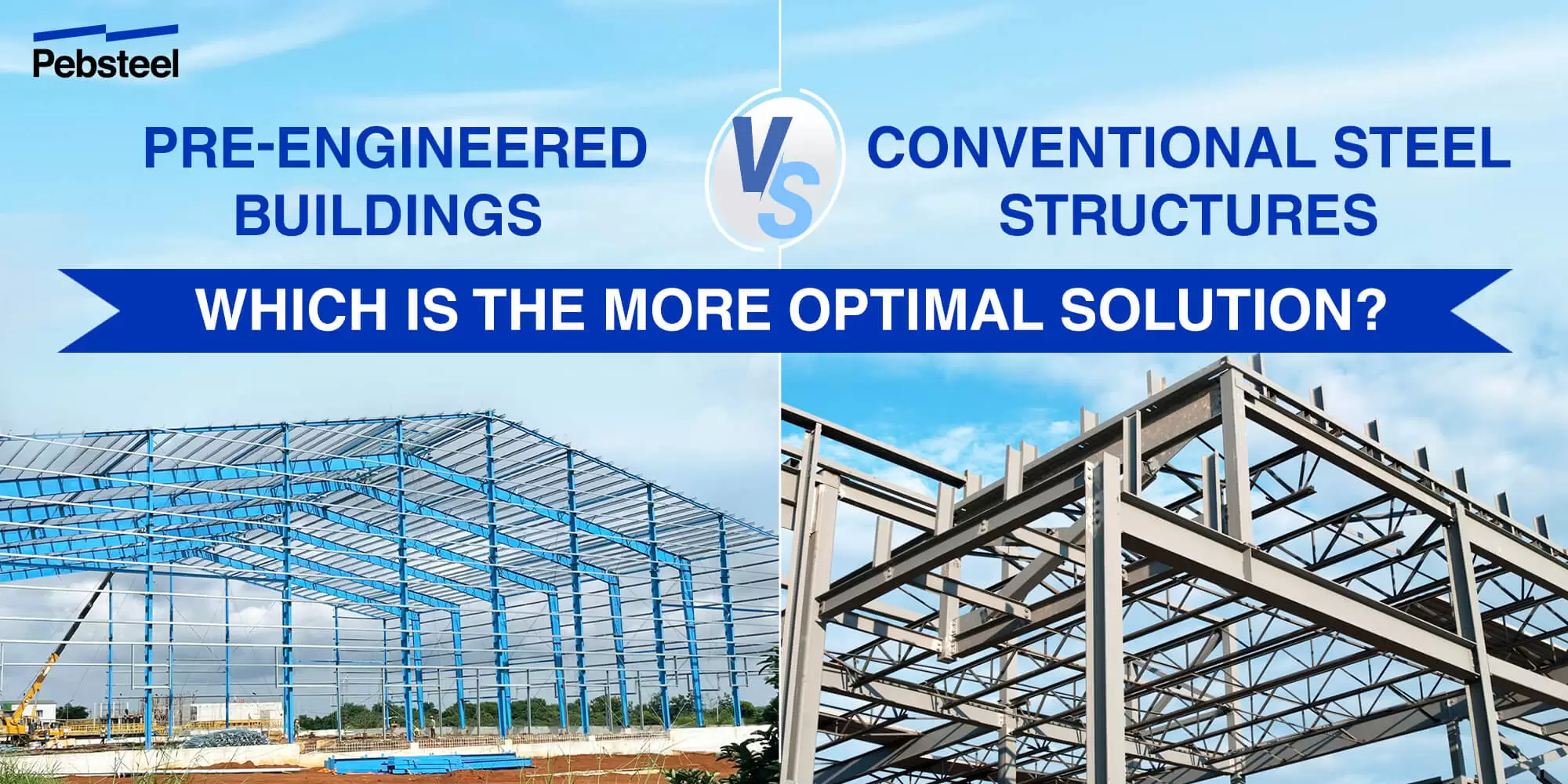
4. Metal Building vs Other Construction Methods
The table below compares pre-engineered metal buildings against the three most common alternative construction methods for industrial and commercial projects:
| Criterion | Metal Building (PEMB) | Reinforced Concrete | Conventional Structural Steel | Tilt-Up Concrete |
| Construction speed | Fast (4–6 months typical) | Slow (10–18 months) | Medium (6–10 months) | Medium-fast (5–8 months) |
| Relative cost (structure only) | Low–Medium | Medium–High | Medium | Low–Medium (large footprints) |
| Clear-span flexibility | Excellent (up to 90 m) | Limited | Good | Fair |
| Design flexibility / expandability | High — bays can be added | Low | Medium | Low |
| Maintenance requirements | Low | Medium (cracking, spalling) | Low–Medium | Medium |
| Multi-storey capability | Limited (1–3 floors) | Excellent | Excellent | Limited |
| Suitability for tropical/coastal climates | High (with correct corrosion spec) | High | High (with correct spec) | High |
5. Metal Building Applications by Industry
Pre-engineered metal buildings serve virtually every sector of the industrial and commercial economy. The most significant applications include:
Warehouses and Logistics Centres
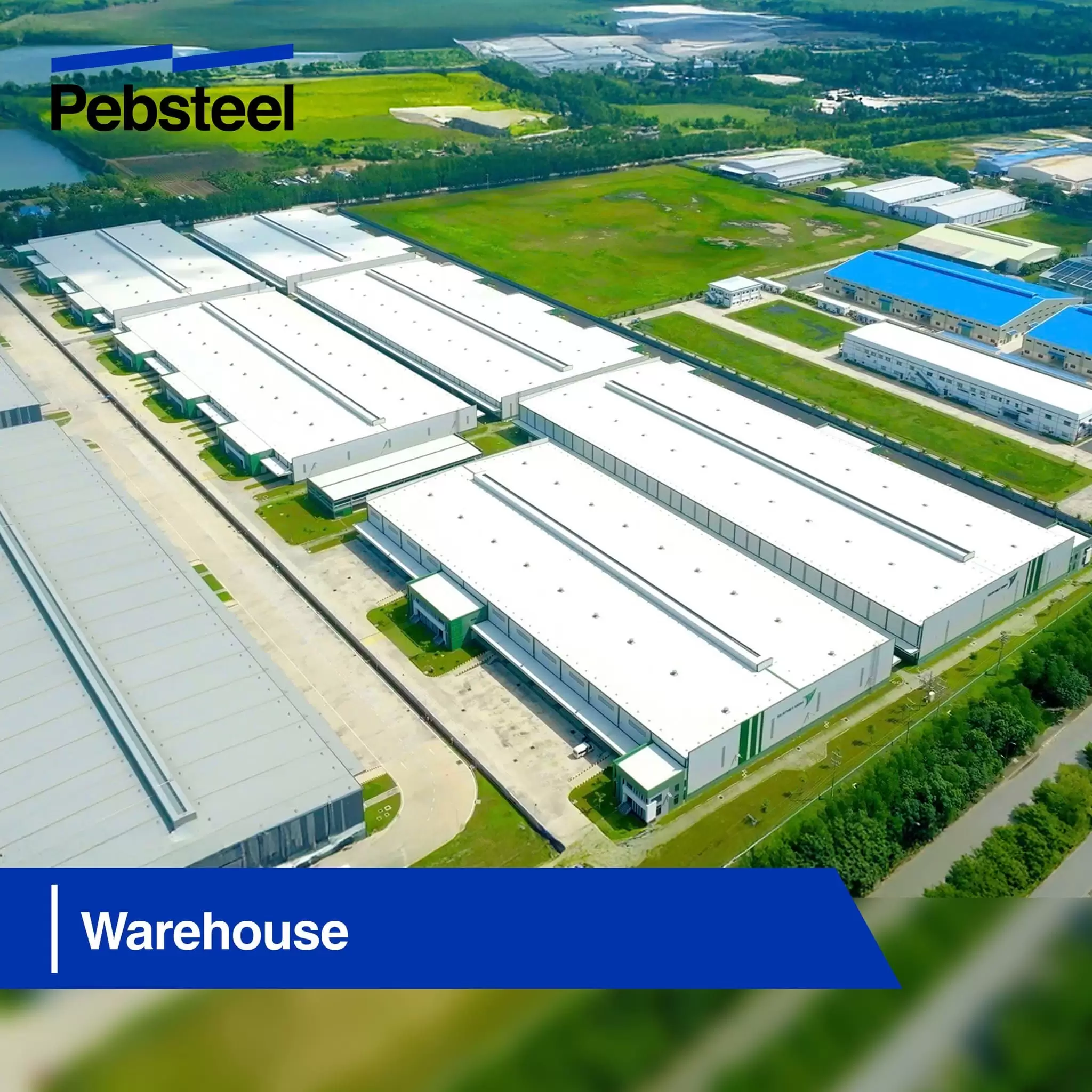
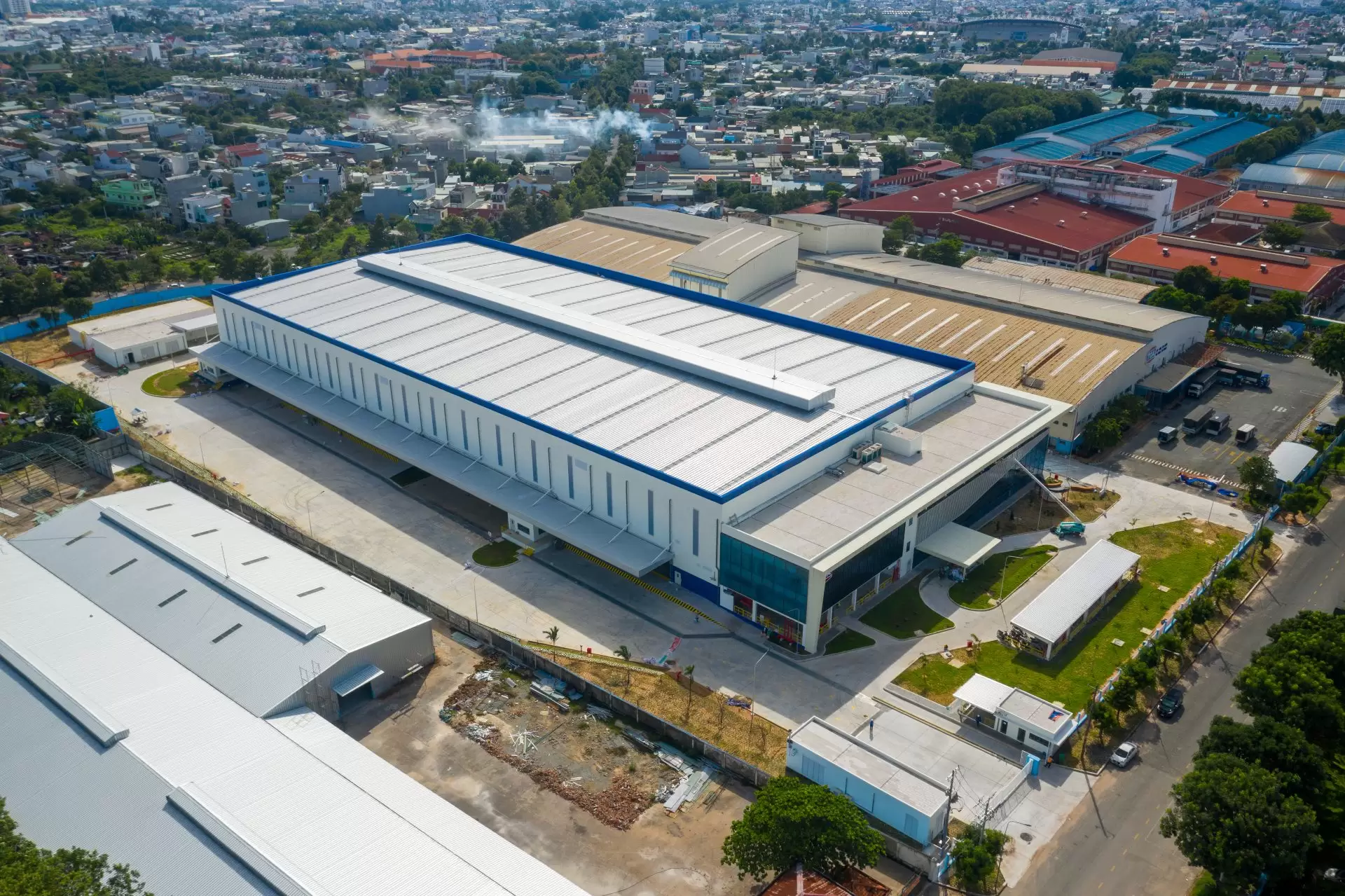
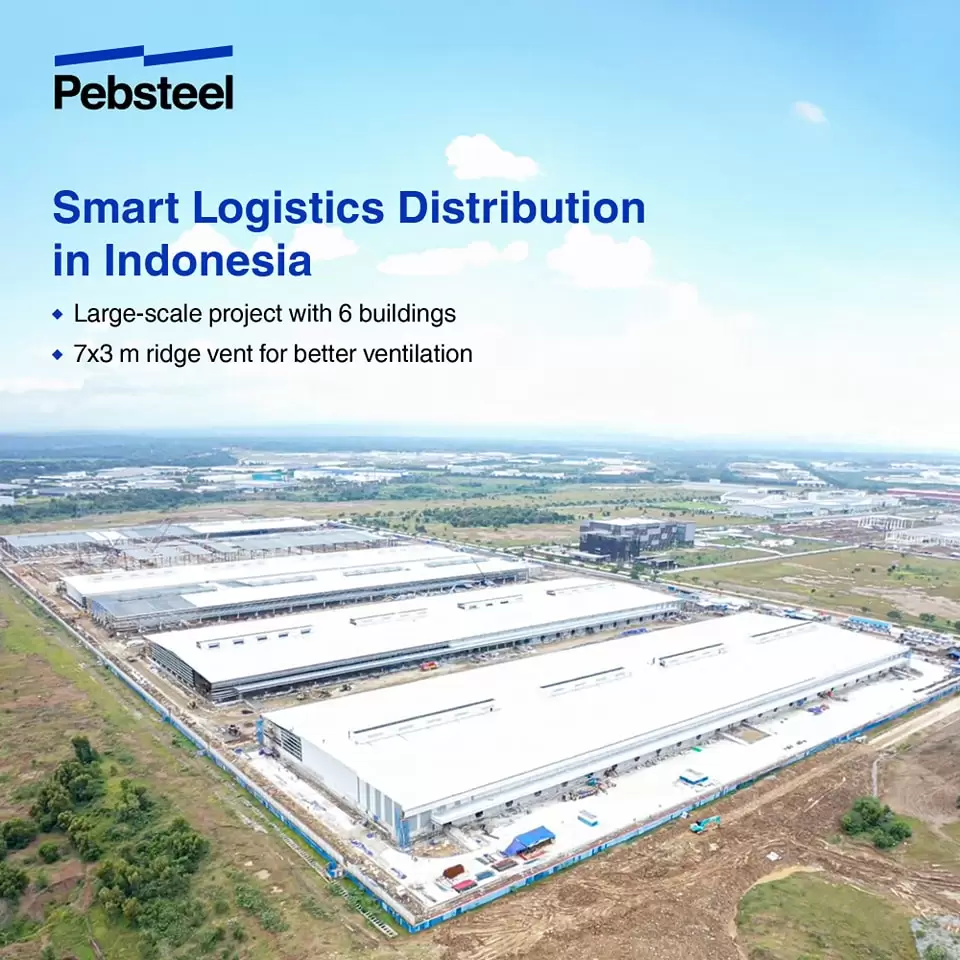
Metal buildings are the global standard for warehouse construction. Clear-span widths of 40–90 m allow double-deep racking at 11-metre heights, while standard bay spacings of 6–9 m align with ISO pallet dimensions and forklift turning radii. Fast construction allows rapid operational deployment — critical for e-commerce fulfilment operators.
Manufacturing and Production Halls
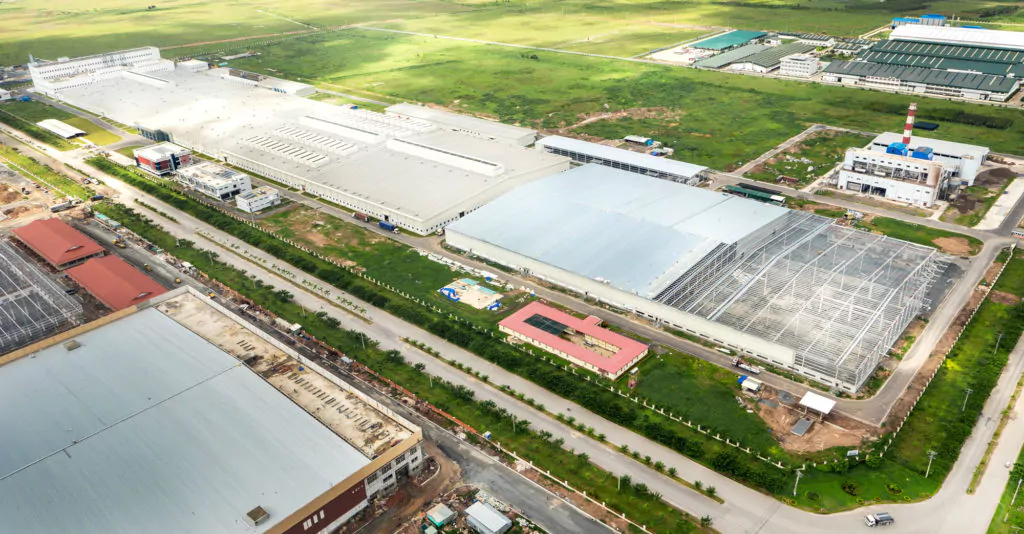
Factories demand adaptability. Pre-engineered steel buildings can integrate overhead crane runway systems (up to 100+ tonnes), heavy-duty concrete floor loadings, process ventilation openings, and future-phase expansion bays — all designed into the primary structure from day one.
Cold Storage and Controlled Atmosphere Facilities
Insulated metal panel (IMP) cladding with polyurethane or PIR cores achieves thermal performance values (U-values) below 0.25 W/m²K without the thermal bridging inherent to conventional construction. Metal buildings therefore form the structural backbone for cold chain facilities serving food processing, pharmaceutical, and horticultural industries.
Aviation Hangars and MRO Facilities
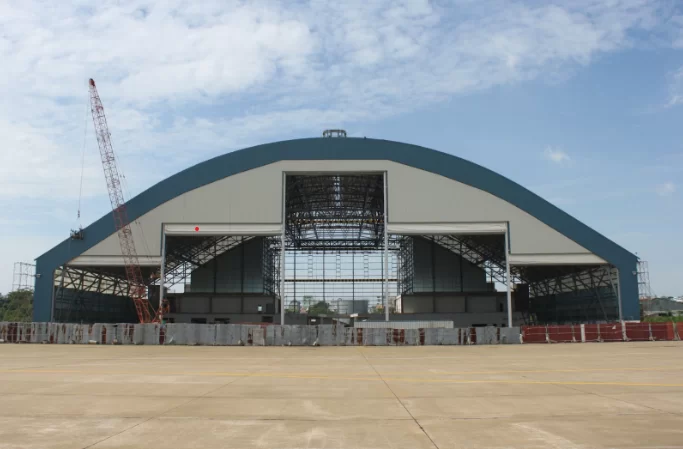
Aircraft maintenance, repair, and overhaul (MRO) hangars demand clear-span widths of 60–90 m with clearance heights of 10–20 m — parameters that suit the clear-span rigid frame system almost exclusively. Steel is also the only viable material for the complex geometries required by bifold or sliding hangar door systems.
Commercial and Retail
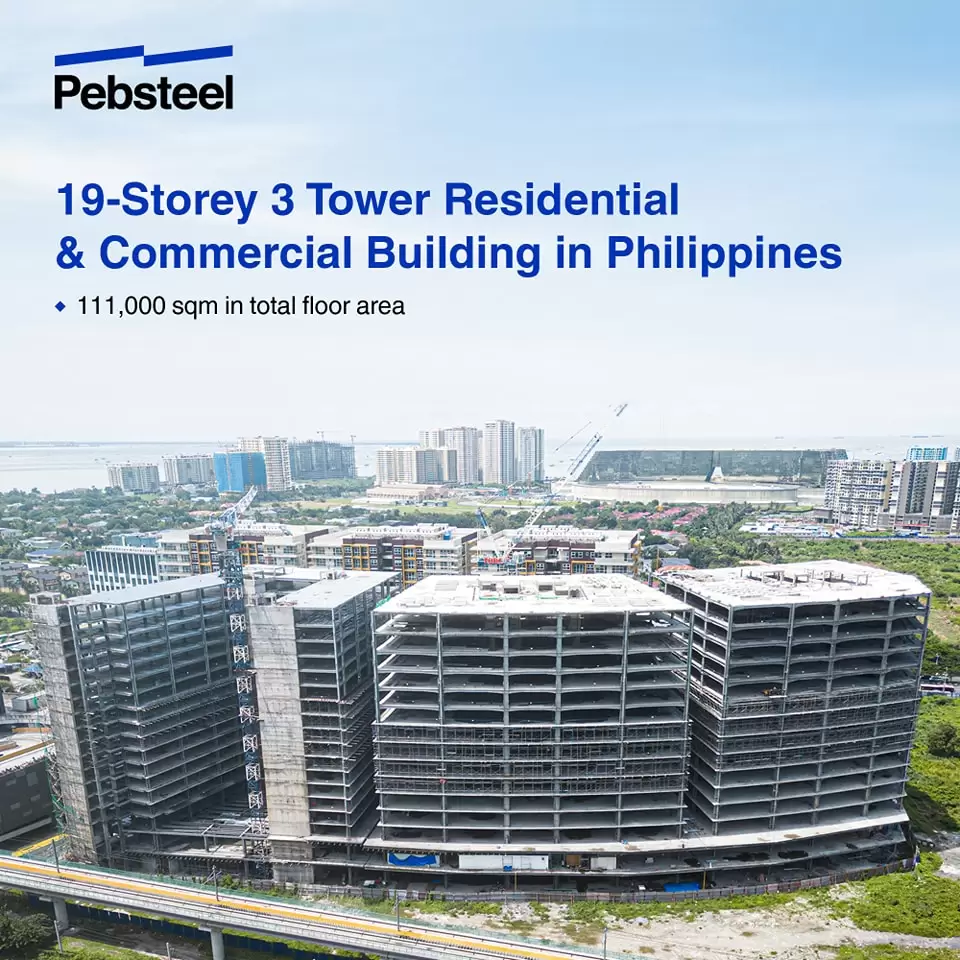
Shopping centres, big-box retail stores, and exhibition halls use pre-engineered steel for long-span roof structures — typically with concrete or masonry infill walls for the building envelope. This hybrid approach delivers structural efficiency alongside the aesthetic versatility demanded by retail brands.
6. Metal Building Costs: Global Benchmarks
Cost data for metal buildings is overwhelmingly US-centric in online resources. The table below provides supply-only and installed cost benchmarks for the major markets PEB Steel serves — a perspective absent from most published guides.
Note: These figures cover the building system (structure + cladding). They exclude foundation, site work, M&E fit-out, and import duties. Always obtain project-specific quotations.
| Market / Region | Supply-Only Kit (USD/m²) | Installed Turnkey (USD/m²) | Key Cost Drivers | Standards Reference |
| Southeast Asia (VN, KH, ID, PH) | USD 30–55 | USD 55–130 | Labour cost low; import duties on steel can apply | AISC / TCVN / SNI |
| Middle East (UAE, KSA, Kuwait) | USD 35–60 | USD 60–140 | Seismic zone low; wind and sand loads critical | AISC / SBC |
| Australia / New Zealand | USD 80–130 | USD 180–350+ | High labour rates; NCC compliance; AS/NZS engineering required | AS 4100 / AS/NZS 1170 |
| USA (for comparison) | USD 14–22 | USD 22–42 | Proximity to mills; highly competitive local market | AISC / MBMA |
What Drives Cost Differences in Metal Buildings?
Several variables move the final cost significantly beyond the base building kit price:
- Span and height: Wider clear spans require heavier tapered frames. Each additional metre of eave height adds column steel and increases wind loads.
- Crane loading: Overhead crane integration requires heavier columns, additional bracing, and runway beam design — often adding 15–30% to the structure cost.
- Corrosion specification: Upgrading from a standard C2 paint system to a C4/C5-rated hot-dip galvanised or high-performance coating system adds USD 8–20/m² but is non-negotiable for coastal or chemical environments.
- Insulation: Adding a single-layer glass wool blanket (75 mm, R-2.5) typically adds USD 5–10/m². Insulated sandwich panels add USD 25–45/m² but deliver dramatically better thermal performance and acoustic control.
- Fit-out and accessories: Roller doors, skylights, ridge ventilation, and guttering are often underestimated. Budget 15–25% of kit cost for accessories.
- Foundation: Not included in kit prices. A standard reinforced concrete slab for a 5,000 m² warehouse typically costs USD 40–80/m² (installed) depending on geotechnical conditions.
READY TO BUILD?
Get a free engineering consultation and itemised quotation from PEB Steel’s team of 100+ structural engineers.
31+ years | 50+ countries | 100+ in-house engineers | AISC-designed buildings
7. Engineering Standards by Region: What Governs Metal Building Design?
One of the most significant content gaps in existing metal building guides is the absence of region-specific engineering standards information — essential for international buyers procuring structures for projects outside North America. The table below maps the primary structural steel codes by region:
| Region | Primary Steel Standard | Load / Wind Code | Notes for Buyers |
| USA | AISC 360, MBMA Metal Building Systems Manual | ASCE 7 | PEMB industry’s home market; most cost data is USD-based here |
| Europe | EN 1993 (Eurocode 3) | EN 1991 (Eurocode 1) | National Annexes modify load factors by country |
| Australia / NZ | AS 4100 / NZS 3404 | AS/NZS 1170.2 (wind), .5 (seismic) | NCC Part B1 governs structural adequacy; ShedSafe® for sheds |
| Southeast Asia | AISC 360 (widely adopted) / TCVN (Vietnam) / SNI (Indonesia) | ASCE 7 or national equivalents | Typhoon wind zones (Philippines, Vietnam) require careful ASCE 7 wind region classification |
| Middle East / GCC | AISC 360 / SBC (Saudi), ADIBC (Abu Dhabi) | ASCE 7 / local codes | Low seismic risk generally; extreme wind (haboob) and thermal loads are the key design considerations |
| Japan | JIS G 3101 / AIJ Recommendations | BCJ seismic standard | High seismic zone; moment-frame design adds significant cost |
PEB Steel designs to AISC 360 as the default global standard and can deliver stamped drawings to EN 1993 or AS 4100 for projects in European or Australian jurisdictions. Buyers should always specify the governing code in the RFQ — it affects frame weight, connection design, and ultimately project cost.
8. Corrosion Considerations: Protecting Your Metal Building in Aggressive Environments
Corrosion is the most common cause of premature metal building degradation — and the most frequently underspecified element in international procurement. ISO 12944 defines six corrosion categories (C1–C5 + CX) based on the environmental aggressiveness:
| Category | Environment Description | Typical Locations | Recommended Coating System |
| C2 | Low corrosivity — dry inland | Rural Vietnam, inland Middle East | Primer + topcoat (70–80 µm DFT) |
| C3 | Medium — urban/industrial | Industrial estates, urban SEA | Epoxy primer + polyurethane topcoat (120+ µm DFT) |
| C4 | High — coastal (>1 km from sea) | Manila Bay area, Da Nang, Dubai coast | Zinc-rich epoxy primer + epoxy intermediate + PU topcoat (200+ µm); AZ150 cladding |
| C5 | Very high — marine / aggressive industrial | Seaports, petrochemical plants, <500 m from sea | Hot-dip galvanising (HDG) + duplex coating; AZ200 or higher cladding (Silver180™ equivalent) |
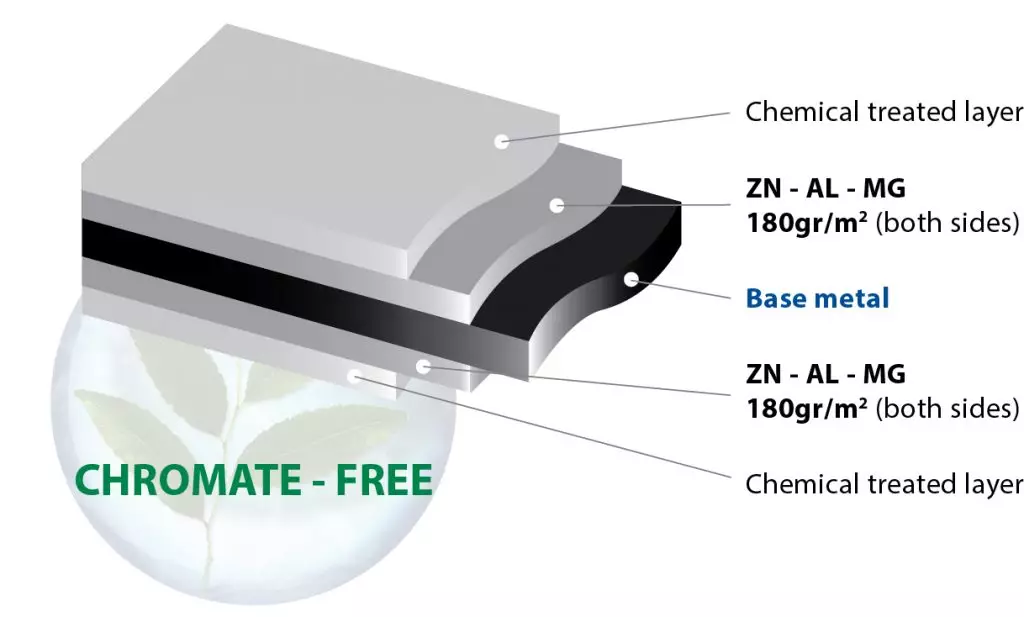
PEB Steel’s proprietary Silver180™ cladding system uses a zinc-aluminium alloy coating weight of 180 g/m² with a PVDF colour coat, rated for C4 environments with a tested design life of 25+ years in Southeast Asian coastal and tropical conditions. For C5-rated facilities (port warehouses, coastal industrial plants), PEB Steel recommends the full HDG + duplex coating system on the primary frame, combined with Silver180™ or AZ200-coated cladding.
More about: Corrosion Protection for Pre-Engineered Steel Buildings
9. The Metal Building Procurement Process: From RFQ to Handover
International buyers unfamiliar with the pre-engineered building supply chain frequently encounter costly delays and scope gaps due to an unclear procurement process. The following eight steps outline the industry-standard process used by PEB Steel:
- Step 1 — Define the building brief: Specify the gross floor area, clear height, span requirements, functional loads (floor load, crane capacity if any), location (for wind/seismic/snow data), governing structural code, and timeline.
- Step 2 — Issue an RFQ to qualified suppliers: Provide the brief plus a site layout plan. Request itemised pricing for supply-only (CIF) and turnkey (erected) options. Require that quotes reference specific structural codes and corrosion specifications.
- Step 3 — Technical evaluation of bids: Compare frame steel tonnages, cladding specifications, connection and anchor bolt details, and scope inclusions/exclusions. Low-tonnage bids are not always better — under-designed frames create costly site problems.
- Step 4 — Detailed engineering and design: Once a supplier is selected, the engineering team produces detailed structural drawings, anchor bolt plans, and connection details for client approval. This phase takes 2–4 weeks for standard buildings.
- Step 5 — Foundation design and construction: The client or their civil contractor installs the reinforced concrete foundation using anchor bolt templates supplied by the building manufacturer. This work typically proceeds concurrently with fabrication.
- Step 6 — Fabrication and quality control: Primary frames are fabricated in the factory under controlled conditions. NDT (magnetic particle or dye penetrant testing) is performed on welds per the applicable AWS D1.1 or equivalent standard.
- Step 7 — Shipping and site delivery: International projects require careful coordination of import documentation, customs clearance, and delivery sequencing. Components are numbered and packed in erection sequence.
- Step 8 — Erection and handover: A trained erection crew (supplier-provided or client-appointed) assembles the building. Final inspections, bolt torque checks, and caulking/sealant application complete the scope. As-built documentation is issued.
Typical Project Timeline by Phase
| Phase | Typical Duration | Notes |
| Design & engineering | 2–4 weeks | Complex or large buildings may take longer |
| Fabrication | 6–12 weeks | Concurrent with foundation works |
| International shipping + clearance | 2–6 weeks | Varies significantly by destination port |
| Site erection | 2–8 weeks | Depends on building size and crew size |
| Total typical project duration | 4–7 months | vs 10–18 months for comparable RC structure |
More about: How to compare Pre-Engineered Steel Building Quotes
10. Sustainability and Green Building: Metal Buildings and ESG
Sustainability considerations are increasingly decisive in capital project approvals — yet almost no existing metal building guide addresses them. Pre-engineered steel buildings have significant environmental credentials that buyers should understand:
- Steel recyclability: Structural steel is 100% recyclable at end of life. Globally, approximately 86% of structural steel is recycled into new steel products, making it one of the most circular construction materials available.
- Reduced construction waste: Factory prefabrication eliminates the on-site concrete formwork, timber shuttering, and off-cuts typical of conventional construction. Site waste is typically reduced by 60–80%.
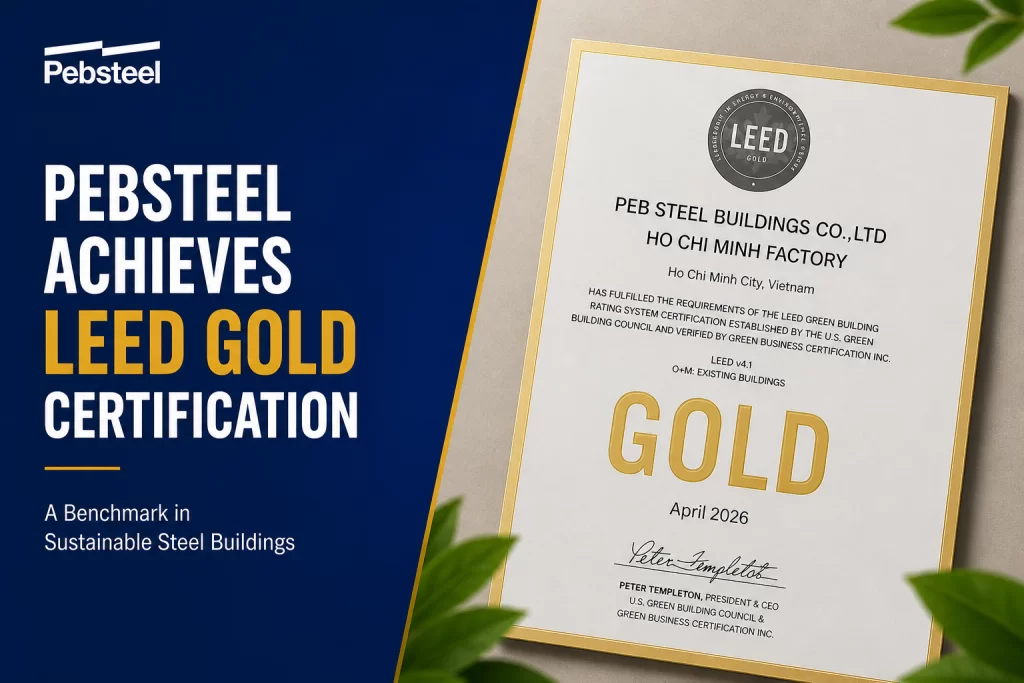
- LEED and Green Star credits: Pre-engineered steel buildings can contribute to LEED v4, BREEAM, and Green Star certification through materials credits (recycled content), construction waste management credits, and energy efficiency credits via high-performance insulated panels.
- Environmental Product Declarations (EPDs): Several major steel coil and structural steel producers now publish ISO 14025-compliant EPDs, enabling precise carbon footprint calculations for project-level sustainability reporting.
- Solar-ready roofs: The standing-seam and trapezoidal profile roofs standard on metal buildings are ideal substrates for flush-mounted solar PV arrays. Pre-engineered buildings increasingly serve as the structural host for rooftop solar — a growing trend in Southeast Asia and Australia.
11. How PEB Steel Designs and Delivers Metal Buildings
PEB Steel is a European-owned pre-engineered steel building manufacturer headquartered in Vietnam, with 31+ years of operational experience and completed projects across 50+ countries spanning South Asia, Southeast Asia, the Middle East, and Australia/New Zealand.
In-House Engineering Capability
With more than 100 in-house structural engineers, PEB Steel handles the complete design cycle — from initial structural concept and load analysis through detailed shop drawings and connection design — using AISC 360 as the primary design code. SAP2000 is used for primary frame analysis; Tekla Structures for 3D detailing and clash coordination. This integrated capability eliminates the coordination delays and scope gaps that arise when design and fabrication are handled by separate parties.
Manufacturing Infrastructure
PEB Steel operates a purpose-built manufacturing facility in Vietnam producing primary frames, secondary members, and ancillary steel components. The production line is ISO 9001-certified, with welding procedures qualified to AWS D1.1. High-tensile steel feedstock is sourced to ASTM A572 Grade 50 specifications.
Proprietary Products
Silver180™ cladding system: A high-durability roof and wall panel system with 180 g/m² zinc-aluminium alloy coating and PVDF colour coat. Rated C4 corrosion environment. 25-year design life for coastal tropical applications in Southeast Asia and the Middle East.
More about: Hyper180® Product Features
Multi-span up to 200 m: PEB Steel’s multi-span frame capability supports total building widths up to 200 m — covering the full spectrum from standard 30 m single-span warehouses to the largest multi-span distribution centres.
Crane-integrated buildings: PEB Steel designs and delivers complete crane-integrated building systems including runway beam design, end stops, and crane cable management — typically for SWL ratings from 2 to 50 tonnes.
More about: Crane Buildings: The Complete Design, Load & Procurement Guide for Pre-Engineered Steel Structures
12. Real Project Examples
The following examples illustrate PEB Steel’s metal building delivery across different market conditions and corrosion environments:
Logistics Distribution Centre — Southeast Asia
A 25,000 m² multi-span distribution centre delivered for a regional 3PL operator. Clear height 10 m. Multi-span rigid frame with 40 m clear bays. AZ150 cladding. Turnkey delivered in 5.5 months from order — 30% faster than the client’s original concrete design programme.
Industrial Manufacturing Facility — Middle East
A 12,000 m² production hall for a building materials manufacturer in the GCC. Single-span clear span of 60 m with 12 m eave height. 20-tonne overhead crane integrated into primary frame. C4 corrosion specification with zinc-rich primer system. Designed to AISC 360 with ASCE 7 wind loads.
Cold Storage Facility — Southeast Asia
A 6,000 m² controlled-atmosphere cold store for a fresh produce exporter. 200 mm PIR insulated sandwich panels achieving U-value 0.18 W/m²K. Internal condensation management integrated into frame design. Delivered with full erection supervision by PEB Steel’s specialist cold-store team.
READY TO BUILD?
Get a free engineering consultation and itemised quotation from PEB Steel’s team of 100+ structural engineers.
31+ years | 50+ countries | 100+ in-house engineers | AISC-designed buildings
Frequently Asked Questions (FAQ)
What is a metal building?
A metal building (also called a pre-engineered metal building or steel building) is a structure whose primary load-bearing system consists of factory-fabricated steel components — columns, rafters, purlins, and cladding — assembled on-site. They are used across industrial, commercial, and agricultural applications worldwide.
How much does a metal building cost per square metre?
Metal building costs vary by region and scope. In Southeast Asia and the Middle East, a supply-only pre-engineered steel building (PESB) kit typically ranges from USD 30–75 per m². In Australia and developed markets, installed turnkey costs run USD 120–300+ per m² depending on specification, site conditions, and fit-out requirements. Always request a detailed itemised quote covering primary structure, cladding, foundation, and erection.
What are the main types of metal building structural systems?
The three main structural systems are: (1) Clear-span rigid frame — column-free interiors up to ~90 m wide, ideal for warehouses and aircraft hangars; (2) Multi-span frame — interior columns added to reduce steel weight for very wide footprints up to 200 m; (3) Modular / lean-to buildings — used as extensions or low-cost ancillary structures. The right choice depends on clear height requirements, crane loads, and span width.
How long does a metal building last?
A properly designed, fabricated, and maintained metal building has a structural design life of 50 years or more under most international codes (AISC 360, EN 1993, AS 4100). Painted or Zincalume-coated roof and wall panels typically carry 20–30-year warranties. In aggressive corrosive environments (coastal, industrial, tropical), specifying a higher corrosion class (C4/C5 per ISO 12944) or proprietary high-durability coating systems significantly extends service life.
What international standards govern metal building design?
The primary standards differ by market: AISC 360 and MBMA (USA, widely adopted globally); EN 1993 Eurocode 3 (Europe); AS 4100 / AS/NZS 1170 (Australia and New Zealand); JIS G 3101 (Japan). For seismic design, ASCE 7, EC8, or NZS 1170.5 apply depending on location.
What is the typical timeline from order to handover?
For a standard industrial metal building: design and engineering (2–4 weeks), fabrication (6–12 weeks), shipping and import clearance (2–6 weeks for international projects), and site erection (2–8 weeks). Total project durations of 4–6 months are common — roughly 40–60% faster than comparable reinforced-concrete construction.
Are metal buildings suitable for tropical and coastal climates?
Yes, but corrosion protection must be correctly specified. In tropical and coastal environments (ISO corrosion categories C3–C5), the structural steel frame should be hot-dip galvanised or primed with a zinc-rich epoxy system. Roof and wall panels should use AZ150 (150 g/m² zinc-aluminium) or higher coatings. PEB Steel’s Silver180™ cladding system is rated for C4 coastal environments with a design life exceeding 25 years.
More about: Roof & Wall Insulation Systems for Pre-Engineered Steel Buildings
Can a metal building incorporate an overhead crane?
Yes. Pre-engineered metal buildings can be designed to accommodate overhead travelling cranes from 1-tonne hoists to 100+ tonne capacity bridge cranes. The primary frame must be sized for the additional crane runway beam loads, dynamic impact factors, and lateral surge forces at the design stage. PEB Steel has extensive experience designing crane-equipped production halls and maintenance facilities.
Disclamer: The content provided in this article is for reference purposes only. For further details or clarification based on your needs, please contact Pebsteel directly.
READY TO BUILD?
Get a free engineering consultation and itemised quotation from PEB Steel’s team of 100+ structural engineers.
31+ years | 50+ countries | 100+ in-house engineers | AISC-designed buildings