
The most common question any PEB manufacturer hears is: “How much does a pre-engineered building cost?” The most honest answer is: it depends — but only on a handful of well-defined variables. Once you understand those variables, you can budget accurately and avoid the costly surprises that derail construction projects.
This guide provides transparent 2026 price ranges based on PEB Steel’s real project data across Southeast Asia, the Middle East, and Australia — the three regions where we operate most actively. We cover supply-only pricing, turnkey cost estimation, the seven biggest cost drivers, and concrete strategies to reduce your total spend without compromising structural performance.
How to use this guide: The price ranges in this article represent supply-only ex-works pricing (building structure and cladding leaving the factory) unless otherwise stated. Erection, foundations, transport, and fitout costs are separate and covered in the turnkey section. All figures are in USD and reflect market conditions as of Q1 2026.

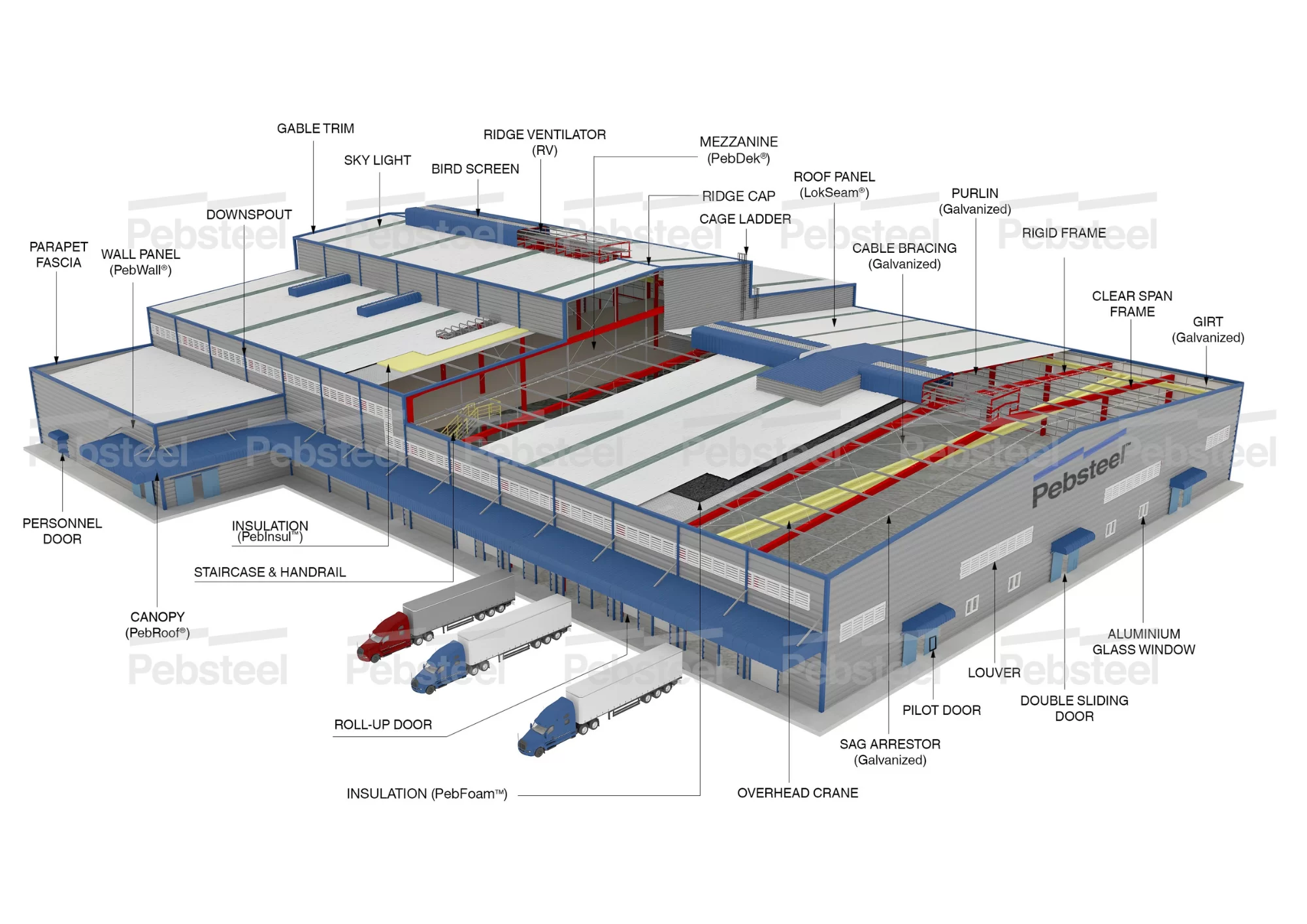
1. Why Pre-Engineered Building Costs Vary So Widely
A pre-engineered building costing USD 90/m² and one costing USD 350/m² are not the same product — they represent fundamentally different structural specifications. The single biggest misconception buyers bring to the market is treating “pre-engineered building” as a commodity with a single price per square metre, like buying timber or concrete.
In reality, a PEB is a custom-engineered structure. The primary steel frame is designed specifically for your building’s dimensions, the design loads at your site (wind speed, seismic zone, snow load), and any special requirements you impose (crane systems, mezzanines, fire-rated panels). Change any one of these inputs and the steel tonnage — and therefore the cost — changes.
The variables that matter most, in rough order of cost impact, are: clear-span width, eave height, design wind/seismic load, crane capacity, insulation specification, cladding system, and geographic delivery distance. We cover each in detail in Section 4.
2. Supply-Only vs. Turnkey Cost: What’s Included?
Before comparing quotes from different PEB manufacturers, it is essential to understand what is — and is not — included in each price. The industry uses two primary pricing models:
| Cost Component | Supply Only (Ex-works) | Supply + Erection (CIF + Erection) | Full Turnkey (Design-Build) |
|---|---|---|---|
| Primary steel structure | ✔ Included | ✔ Included | ✔ Included |
| Secondary members (purlins, girts) | ✔ Included | ✔ Included | ✔ Included |
| Roof & wall cladding | ✔ Included | ✔ Included | ✔ Included |
| Accessories (doors, gutters, trim) | ✔ Included | ✔ Included | ✔ Included |
| Factory-to-port freight | ❌ Buyer arranges | ✔ Included | ✔ Included |
| Import duties & clearance | ❌ Buyer arranges | ❌ Buyer arranges | ✔ Included |
| Foundation / civil works | ❌ Separate | ❌ Separate | ✔ Included |
| On-site erection | ❌ Separate | ✔ Included | ✔ Included |
| M&E, fit-out, floor slab | ❌ Separate | ❌ Separate | ✔ Included |
| Typical cost multiplier vs. supply-only | 1.0× | 1.3–1.6× | 2.0–3.0× |
Buyer alert: When comparing quotes, always confirm whether foundation design, local authority approval drawings, and erection supervision are included. These omissions are the most common source of budget overruns. A “cheaper” supply-only quote that excludes erection supervision can cost more in total than a higher supply + erection quote that includes full site management.
3. Full Cost Breakdown: Supply Package Components
Within the supply-only price, cost is distributed across the following components. Understanding this distribution helps buyers identify where specification changes will have the most impact:
| Component | % of Supply Cost | USD/m² (basic) | USD/m² (premium) | Notes |
|---|---|---|---|---|
| Primary steel frames | 42–52% | $38–60 | $85–140 | Drives with clear span, height, crane loads |
| Secondary members | 10–14% | $9–14 | $18–28 | Purlins, girts, eave struts |
| Roof cladding & insulation | 14–20% | $12–20 | $32–60 | Single-skin vs. sandwich panel range |
| Wall cladding | 8–12% | $7–12 | $18–36 | Standard sheeting vs. composite panels |
| Doors, windows & trim | 6–10% | $5–10 | $14–28 | Varies greatly with opening count |
| Accessories & specials | 4–8% | $4–8 | $12–30 | Ridge ventilators, skylights, etc. |
| Total supply (ex-works) | 100% | $80–130 | $200–400+ | Crane systems add $15–80/m² separately |
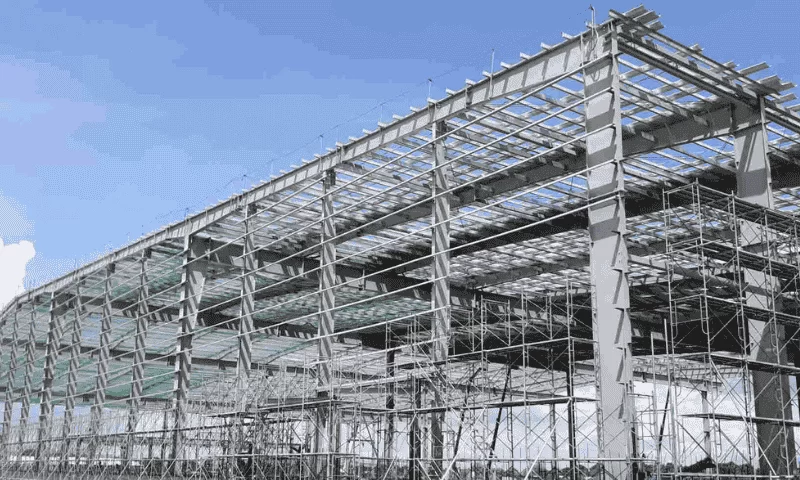
The primary steel frame — columns, rafters, and their connections — is by far the largest single cost item in any PEB project. This is why the structural specification (particularly clear-span width and crane capacity) has such an outsized effect on total price. A 40-metre clear-span frame requires dramatically more steel than a 20-metre frame for the same floor area.
4. Seven Factors That Drive the Final Price
1. Clear-Span Width
Impact: ★★★★★ (highest)
Wider clear spans require exponentially heavier primary frames. Each 10-metre increase in span width can add 20–35% to steel tonnage. Multi-span frames with interior columns are the most cost-effective option for very wide buildings.
2. Eave Height
Impact: ★★★★☆
Taller eave heights increase column length, wall cladding area, and wind moment — all of which add steel and cost. Every additional metre of eave height adds approximately 4–8% to the supply cost for mid-span buildings.
3. Design Wind Speed
Impact: ★★★★☆
Buildings in typhoon regions (Philippines, Vietnam) or cyclone zones (Australia Regions C/D) require heavier frames, larger anchor bolts, and stronger connections. High-wind designs can add 15–30% to primary frame cost versus low-wind sites.
4. Crane System
Impact: ★★★★☆
Overhead crane beams transfer large eccentric loads into the primary frame, requiring heavier columns and modified connections. A 10-tonne crane system can increase primary frame steel by 25–40%. Heavy cranes (50–200 t) command premium pricing.
5. Insulation Specification
Impact: ★★★☆☆
Uninsulated single-skin cladding is lowest cost. Glasswool blanket insulation adds USD 8–15/m² of cladding area. Polyurethane (PIR) sandwich panels add USD 25–45/m² but deliver dramatically better thermal performance.
6. Delivery Distance
Impact: ★★★☆☆
For export projects, ocean freight from Vietnam to destination port adds USD 15–40/m² depending on destination and vessel rates. Australia and the Middle East involve different freight routes with different transit times and port costs.
7. Steel Price Volatility
Impact: ★★★☆☆
Hot-rolled coil (HRC) and plate steel prices fluctuate with global commodity markets. In 2025–2026 pricing is relatively stable, but a 10% move in steel prices translates directly into a 5–8% movement in supply-only PEB cost. Lock prices on contract.
5. Regional Price Guide: SEA, Middle East & Australia (2026)
The supply-only price from the factory is the same regardless of destination — but total project cost varies significantly by region due to freight costs, import duties, local erection labour rates, and foundation requirements. The following benchmarks are based on PEB Steel’s 2024–2026 project portfolio.
Vietnam | $120–220/m² supply + erect
Low erection labour costs. No import duties (domestic supply). High wind-load designs required in coastal provinces. Lead time advantage: 2–4 weeks shorter than export projects. Fastest market in SEA.
Thailand/ Malaysia | $150–280/m² supply + erect
Moderate import duties (5–15% depending on HS code classification). Relatively low erection labour. Strong demand from automotive and electronics manufacturing sectors.
Philippines | $160–300/m² supply + erect
Super-typhoon design zones (NSCP Seismic Zone 4) require premium primary frames. Island logistics add freight cost. PEZA zone projects may qualify for duty-free import treatment.
UAE/ Saudi Arabia | $180–340/m² supply + erect
High-UV and extreme heat require premium coating systems (+10–15%). Seismic requirements in some zones. GCC 5% customs duty applies. High erection labour productivity offsets wage premiums.
Australia | $220–420/m² supply + erect
AS/NZS 1170 cyclone regions (WA, QLD, NT) impose the highest wind design costs globally. Union labour rates drive erection costs. 5% customs duty. NATSPEC documentation required. Highest total cost region, but strong ROI due to long asset life.
Indonesia | $140–260/m² supply + erect
Growing logistics and manufacturing demand. High seismic design requirements (one of the world’s most active seismic zones). Import duties vary; KPBPB (bonded zone) projects may qualify for exemptions.
Note on foundation costs: The regional ranges above exclude civil works and foundations, which vary enormously by site conditions. Isolated pad footings on good ground may add USD 15–25/m² to the total project cost, while piled foundations on poor ground in coastal Southeast Asia can add USD 40–80/m² or more. Always complete a geotechnical investigation before finalising your project budget.

6. Five Proven Ways to Reduce Your PEB Cost
These are the highest-impact cost reduction levers that PEB Steel’s engineering team applies routinely — without compromising structural performance or safety:
- 01. Use multi-span instead of clear-span where operations allow
- Interior columns reduce primary frame steel dramatically. If your operations can tolerate a column every 20–30 metres (common in most manufacturing, logistics, and retail applications), switching from 60-metre clear-span to 3 × 20-metre multi-span can reduce steel tonnage — and cost — by 25–40%. This is the single most powerful cost lever available.
- 02. Specify the correct wind zone — not a conservative over-estimate
- Many clients specify a higher design wind speed than their site actually requires “to be safe.” Every 10 m/s increase in ultimate design wind speed adds approximately 8–15% to primary frame cost. Use a licensed local engineer to confirm the correct wind zone from the applicable standard (ASCE 7, AS/NZS 1170, or local equivalent).
- 03. Optimise eave height to the minimum operationally required
- Each additional metre of eave height adds column length, wall cladding area, and wind moment. For a warehouse where maximum racking height is 9 metres, specify 10.5-metre eaves (allowing for beams and sprinkler clearance) rather than 12 metres. This typically saves 6–12% on supply cost for standard spans.
- 04. Match insulation specification to actual thermal performance requirements
- Don’t specify PIR sandwich panels for an untempered storage building just because they look premium. Single-skin with 75 mm glasswool blanket (R-value ~2.5 m²K/W) is adequate for many applications at 30–40% less cost than equivalent sandwich panels. Reserve high-performance insulation for cold-chain, food processing, and data-centre applications where energy savings genuinely justify the investment.
- 05. Engage the PEB manufacturer early in design — before architectural drawings are fixed
- The most expensive projects are those where an architect fixes the building layout and then asks for a PEB price. Structural inefficiencies are baked in. Engaging PEB Steel at conceptual stage allows our engineers to optimise column grid, frame spacing, and bay width — often reducing steel tonnage by 12–20% with no change in usable floor area or building function.
Frequently Asked Questions — PEB Cost
How muc does a pre-engineered building cost per square metre in 2026?
A basic supply-only pre-engineered building (standard cladding, no crane system, no insulation) is typically USD 80–150 per m² ex-works factory in 2026. A fully insulated, crane-equipped building with premium cladding ranges from USD 200–400+ per m² supply. Turnkey prices including foundations, erection, and M&E fitout are typically 2–3× the supply-only cost depending on location. These ranges apply to single-storey industrial and commercial buildings in the 1,000–20,000 m² range — the most common PEB application.
What is the biggest cost driver for a pre-engineered building?
Does insulation significantly increase the cost of a pre-engineered building?
Yes — insulation is one of the most significant specification-driven cost add-ons. Single-skin uninsulated cladding is the lowest-cost base option. Glasswool blanket insulation (75–100 mm) adds approximately USD 8–15/m² of roof area. Insulated sandwich panels with PIR or mineral wool core add USD 20–45/m² of cladding area but deliver superior thermal performance (U-values as low as 0.19 W/m²K) and are often required for cold-chain, food processing, and climate-controlled facilities. The lifetime energy savings from premium insulation typically justify the additional upfront cost within 5–8 years in tropical and arid climates.
How do I get an accurate cost estimate for my pre-engineered building project?
To receive a detailed budgetary estimate from PEB Steel within 48 hours, provide five pieces of information: (1) building footprint — length × width; (2) eave height; (3) building use and any special requirements (crane capacity, insulation, mezzanine, cold room); (4) site country and nearest major city; (5) target completion date. These inputs allow our engineers to size the primary structure and produce a realistic cost range at no charge. Contact us at pebsteel.com/contact-us or through your nearest regional office.
Disclamer: The content provided in this article is for reference purposes only. For further details or clarification based on your needs, please contact Pebsteel directly.